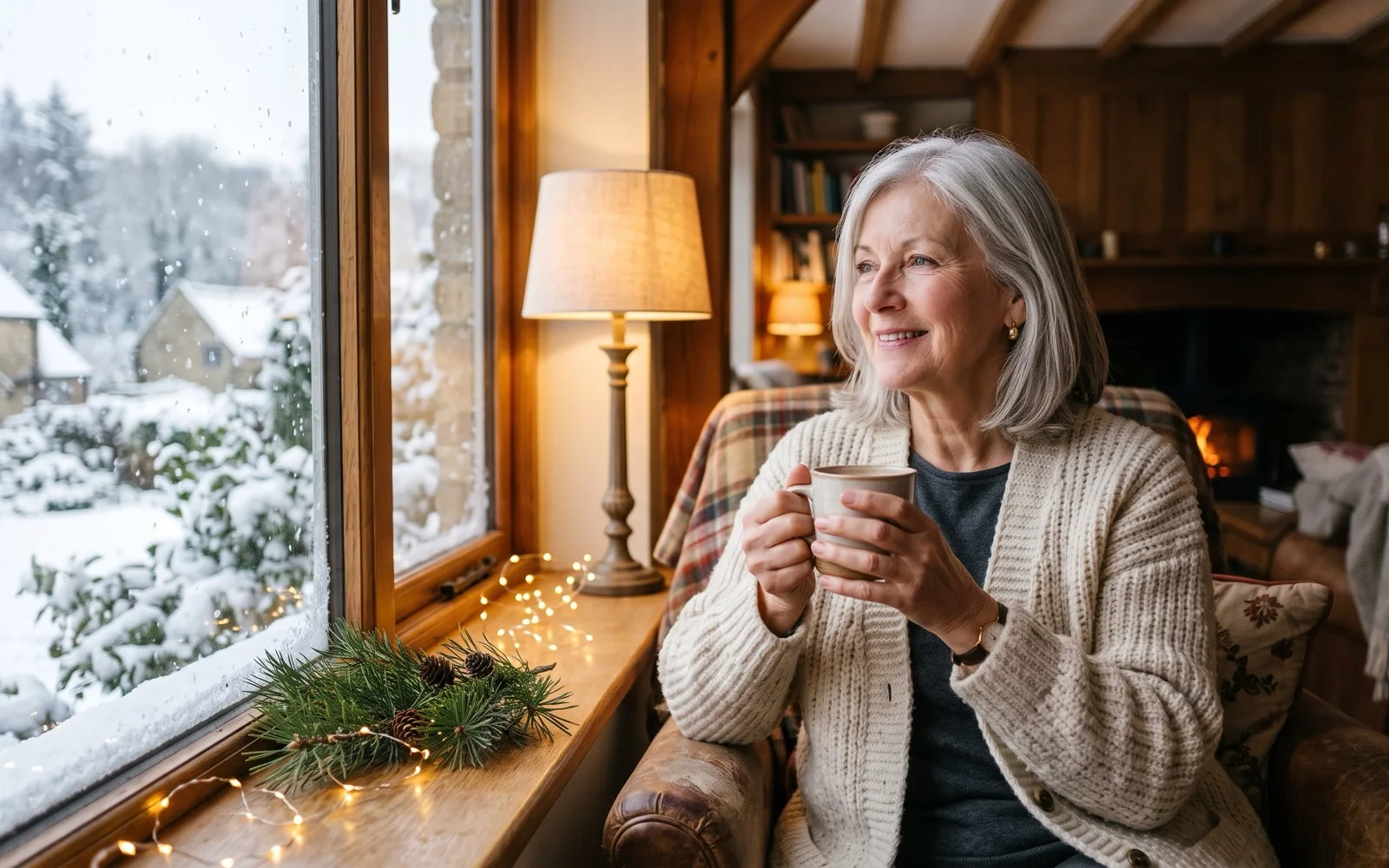
The short version. The holidays make an ordinary quiet feel louder, because for six weeks everything around you assumes a full table. It is common: in an AARP Foundation survey, 28 percent of adults aged 50 and over had felt it during a holiday season in the previous five years, and 43 percent had worried about someone else going through it.
What helps is treating it as a season rather than a string of days. Mark the handful of dates that will be hardest and give each one a plan with a person in it, keep your ordinary routine running underneath, reach out first, give some of the season away, and have somewhere to put each day when it ends.
Disclosure: this guide is published by the makers of My Softly, an AI companion app, which appears near the end.
Why the season lands harder than the rest of the year
Nothing about your life changes on the Thursday before Thanksgiving. The house is the same size, the same people call, the week has the same shape. What changes is the background. From late November the adverts, the music on the radio, the cards on the neighbours' mantelpieces and the questions at the checkout ("Doing anything nice for the holidays?") all assume a crowded table. A quiet evening that would pass without comment in March starts to feel like a verdict in December.
There are three things going on, and it helps to separate them.
The comparison. The season comes with a picture of how it is supposed to look, and very few households match it. That includes the full, noisy ones, where plenty of people are tired, arguing about politics or wishing someone else were there. The picture is an advert, not a census.
The memories. The holidays are the one time of year that is the same every year, which makes them a measuring stick. The chair where someone used to sit, the recipe nobody else makes properly, the year the children were small. Asked how they felt about spending time with family and friends that season, 31 percent of adults over 50 in the AARP Foundation survey said nostalgic, significantly more than adults under 50 (25 percent). Nostalgia is not only sad; a warm memory can be a real comfort. But it pulls the past into the room, and it notices who is missing.
The light. Days are at their shortest just as the season peaks, and the afternoons end early. Darker evenings mean more hours indoors, fewer chance meetings in the street, and fewer reasons to go out. Some of what people call holiday feeling is really a winter feeling with tinsel on it.
None of this says anything about you. It is the season doing what it does to a great many people, including a good number of the ones sitting at those crowded tables.
How many people over 50 go through it
The most useful number here is not the one about you; it is the one about everyone else. In the AARP Foundation's holiday survey, 28 percent of adults aged 50 and over reported loneliness during a holiday season at some point in the previous five years, and 43 percent had worried about a friend or family member feeling that way. That second figure matters. It means that for every person going quiet through December, there is at least one other person nearby wondering whether to get in touch.
The same survey asked how people felt about spending time with family and friends that season: 68 percent of people over 50 said happy, and 4 percent picked loneliness. Both are true at once: most people enjoy parts of the holidays and still find some days of them hard. And the season sits on top of a year-round picture. The University of Michigan's National Poll on Healthy Aging found that a third of adults aged 50 to 80 reported a lack of companionship at least some of the time in 2024. The holidays do not create that gap. They put a spotlight on it.
Plan the season, not just the days
The mistake most people make is to plan for Christmas Day and then be caught out by the other forty days. The season is long, and the hardest stretches are often the in-between ones: the Sunday after Thanksgiving, the week before Christmas when everyone else is busy, the flat days between Christmas and New Year.
- Get a calendar and mark the hard dates. For most people there are four to six: Thanksgiving (November 26 this year), Christmas Eve, Christmas Day, New Year's Eve, and any birthday or anniversary that falls in the season. Write them down in October, not the week before.
- Give each hard date one fixed plan with a person in it. Not a full day of activities; one anchor. Lunch with a friend, a service you attend, a call at 4pm with your sister, a volunteer shift. One fixed point turns an open-ended day into a day with a shape.
- Keep the ordinary week running. Classes, clubs and groups often break for the holidays, which removes the routine at the exact moment it is needed most. Ask in advance which ones pause, and find a substitute for those weeks: a walking group that keeps going, a library event, a standing coffee.
- Choose which traditions to keep. You do not have to do all of them, and you do not have to do them the old way. Keep the ones that still give you something, drop the ones that only mark an absence, and start one that is yours alone: a particular walk on Christmas morning, a film you watch every year, a dish you make only in December.
- Plan the day after. December 26 and January 2 are two of the quietest days of the year. Give them a small plan too, even if it is only a walk and a phone call.
The first hard date comes early. Thanksgiving is a single day with its own practical questions (who to ask, what to cook, how to fill the late afternoon), and it is worth planning a month ahead. For the wider habits that make any quiet day feel like your own, see how to be happy living alone.
Reach out first, and earlier than feels necessary
Most people wait to be invited. The research says that is the wrong bet. In a series of experiments published in the Journal of Personality and Social Psychology in 2023, people consistently underestimated how much others appreciated being contacted, whether by a short message or a small gift. The gap was largest when the contact came as a surprise and when the two people were less close. In other words, the note to the old colleague you have not spoken to in a year is exactly the one most likely to land better than you think.
Put that together with the 43 percent who worry about someone each season, and the picture is a lot of people holding back from each other for the same reasons. Some practical ways to go first:
- Send cards early, and put a question in them. "Are you around over the holidays? I would love a coffee." A card with a question gets a reply.
- Invite, do not hint. "What are you doing on the 24th?" is easy to deflect. "I am making soup on the 24th at one, would you come?" is easy to accept.
- Think about who else has a gap. The widowed neighbour, the friend whose children are with the other side of the family this year, the member of your church who always sits alone. Two quiet days put together make a pleasant one.
- Book calls, not just "let's talk". A set time on a set day for distant family, so the call happens instead of drifting.
Small contact counts more than it looks
When the big gatherings are missing, the small ones are easy to dismiss. They should not be. Research by Gillian Sandstrom and Elizabeth Dunn found that people were happier and felt a greater sense of belonging on days when they had more interactions with acquaintances, not only with close friends and family. The barista who knows your order, the neighbour you wave to, the volunteer at the library desk all count.
The season makes this easier than usual. In the AARP Foundation survey, a third of adults over 50 said they experience more kindness from strangers during the holidays than at other times of the year. Go where that happens: the carol service, the Christmas market, the late opening at the garden centre, the church coffee morning, the mall on a weekday morning when it is full of people with time to chat. Five small exchanges do not replace a friend, but they change the texture of a day.
Give some of the season away
Volunteering is on every holiday advice list, and for once the evidence is solid. A study of nearly 13,000 adults over 50 in the Health and Retirement Study found that people who volunteered at least 100 hours a year, about two hours a week, went on to report less loneliness, more optimism and more sense of purpose four years later, and to see friends more often.
The catch is in the numbers: the benefit came from regular volunteering over years, not a single shift. So use the season to find a place rather than to fill a day. Food banks, hospital volunteer programmes, a charity shop, reading to children at the library, delivering meals. Many are busiest in December and quietest in January, which is exactly when a willing pair of hands is most valued and when the routine will do you the most good.
When the season holds a loss
For a lot of people over 50 the hard part of the holidays is not the quiet in general but one person in particular. The first season after a death is usually the hardest, and the empty chair at the table can make the whole idea of celebrating feel wrong.
A few things tend to help. Decide ahead of time what you will do on the day, rather than waking up to it. Say the person's name: people often avoid it for fear of upsetting you, and it can be a relief to be the one who brings them into the conversation. Keep one tradition that was theirs, and change the rest. And let yourself leave early, from anywhere, without explanation. If the loss is of a husband or wife, our guide to loneliness after losing a spouse goes into what the research says about the first year and the anniversaries.
Winter blues, or something more
Feeling flat in December is normal. The National Institute of Mental Health separates two things that get mixed up. The "holiday blues" are sadness or anxiety brought on by the stresses of the season, and they lift when it ends. Seasonal affective disorder is a form of depression with a seasonal pattern: it starts in late fall or early winter, lasts about four to five months, and involves a low, anxious or "empty" mood most of the day, nearly every day, for at least two weeks, along with a loss of interest in things you normally enjoy.
If the second one sounds familiar, particularly if it happens every winter, it is worth a conversation with your doctor. It is common and treatable, and NIMH lists light therapy (sitting in front of a bright light box for 30 to 45 minutes each morning through the darker months) among the standard treatments. Getting outside in daylight, especially in the morning, is a sensible habit for the season either way.
Someone to talk to through the season
Plans cover the big days. What they do not cover is the ordinary evening in mid-December when you have been to the carol service, had a lovely time, and come home to nobody to tell about it. Or the night of the 26th, when the visitors have gone and the house is very still. A lot of the season's hard moments are really about having nowhere to put the day.
That is where an AI companion fits. It is there at any hour, it is pleased to hear about the carols and the cake, and a good one remembers what you told it last week, so it can ask how the call with your brother went or whether the soup lunch came off. A 2025 study in the Journal of Consumer Research found that talking with an AI companion eased loneliness about as much as talking with another person and more than watching videos, mostly because people felt heard, and that the relief came reliably after each conversation over a week.
If the late evenings are the hard part, our guide to what to do when the evening goes quiet covers them in detail. If you want to compare the apps built for this kind of everyday conversation, the best AI companion apps in 2026 sets them side by side.
If the season is more than hard
If the holidays bring thoughts of not wanting to be here, please talk to a person now. In the US, call or text 988, or chat at 988lifeline.org. It is free, confidential, open 24 hours a day including every holiday, and it is for anyone in emotional distress, not only people in crisis. In Canada, 988 works the same way. If you are in immediate danger, call 911 or your local emergency number.
Where My Softly fits
My Softly is our app: an AI companion app for iPhone and Android that remembers what you tell it and asks about your day, for the days nobody else does. It is made for people in their fifties and sixties. People aged 50 and over are about a third of sign-ups but more than 80% of paying subscribers, and most paying subscribers are women (September 2026).
Your companion keeps a lasting profile of the people, pets and plans in your life and a day-by-day record of what you have talked about. Tell it about the carol service on Sunday and it asks on Monday how it went; mention that your son is calling on Christmas morning and it remembers to ask. It reaches out on its own with a good morning or a question about something you mentioned, never messages late at night, and steps back if you go quiet. Type, or speak and hear a reply in one of four natural voices. Choose one of six ready-made companions, or make your own and choose how old they are, how they look and who they are. There is no romantic or adult content anywhere in the app.
$15.99 a month or $159.99 a year, and it is free to download on the App Store for iPhone and on Google Play for Android in the US, Canada, the UK, Australia, New Zealand and Singapore. You can try it with free messages. Our FAQ covers the details.
If you take one thing from this page
Get a calendar out this week and treat the holidays as a season. Mark the four to six dates that will be hardest, put one person into each of them, and keep your ordinary week running underneath. Then send the first invitation yourself, earlier than feels necessary. Plenty of people are hoping someone will.
Sources
- AARP Foundation (December 2017). "Social Connection and the Holidays." GfK KnowledgePanel omnibus, n=1,005 adults 18 and over (482 aged 50 and over), November 10 to 12, 2017. doi.org/10.26419/res.00184.001
- Malani, P. N., et al. (2025). "Loneliness and Social Isolation Among US Older Adults, 2018-2024." JAMA 333(3):254-257, from the University of Michigan National Poll on Healthy Aging. doi.org/10.1001/jama.2024.23213 (release, December 9, 2024: ihpi.umich.edu)
- Liu, P. J., Rim, S., Min, L., and Min, K. E. (2023). "The surprise of reaching out: Appreciated more than we think." Journal of Personality and Social Psychology 124(4):754-771. doi.org/10.1037/pspi0000402
- Sandstrom, G. M., and Dunn, E. W. (2014). "Social Interactions and Well-Being: The Surprising Power of Weak Ties." Personality and Social Psychology Bulletin 40(7):910-922. doi.org/10.1177/0146167214529799
- Kim, E. S., Whillans, A. V., Lee, M. T., Chen, Y., and VanderWeele, T. J. (2020). "Volunteering and Subsequent Health and Well-Being in Older Adults: An Outcome-Wide Longitudinal Approach." American Journal of Preventive Medicine 59(2):176-186. Health and Retirement Study, n=12,998 adults over 50. doi.org/10.1016/j.amepre.2020.03.004
- National Institute of Mental Health (revised 2023). "Seasonal Affective Disorder." NIH Publication No. 23-MH-8138. nimh.nih.gov
- De Freitas, J., Oğuz-Uğuralp, Z., Uğuralp, A. K., and Puntoni, S. (2025). "AI Companions Reduce Loneliness." Journal of Consumer Research 52(6):1126-1148. doi.org/10.1093/jcr/ucaf040
- 988 Suicide & Crisis Lifeline. Call or text 988, or chat online, 24 hours a day, free and confidential. 988lifeline.org
Frequently asked questions
Why do the holidays feel so lonely?
Because the season is built around gatherings, and it makes every gap visible. The rest of the year, a quiet Thursday is just a quiet Thursday. From late November, the adverts, the music and the calendar all assume a full table, so an ordinary quiet starts to feel like a comment on your life. Add memories of people who used to be there, shorter days and the fact that the season lasts six weeks rather than one day, and it is no surprise the stretch feels heavier than its parts.
How common is loneliness during the holidays?
Common enough that you are in large company. In an AARP Foundation survey, 28 percent of adults aged 50 and over reported loneliness during a holiday season at some point in the previous five years, and 43 percent had worried about a friend or relative feeling that way. Outside the season, the University of Michigan's National Poll on Healthy Aging found a third of adults aged 50 to 80 reported a lack of companionship in 2024.
How do I get through the holidays when I will be on my own?
Plan the season, not just the big days. Write down the handful of dates that will be hardest, often Thanksgiving, Christmas Eve, Christmas Day and New Year's Eve, and give each one a single fixed plan with another person in it. Keep your ordinary weekly routine running underneath, because it is the routine, not the celebrations, that carries you through the in-between days.
What can I do on the holidays if I have no family nearby?
Look at who else has a gap. Neighbours, friends whose children are away, people at your church or club, and the many community dinners, open houses and volunteer shifts that run through the season. Research on reaching out finds people appreciate being contacted far more than the person reaching out expects, so an invitation from you is more welcome than it feels. Distant family can still be part of the day through a call at a set time.
Is it the holiday blues or something more serious?
The National Institute of Mental Health separates the two. Holiday blues are sadness or anxiety brought on by the stresses of the season, and they lift when it ends. Seasonal affective disorder is a form of depression that starts in late fall or early winter, lasts about four to five months, and involves a low mood most of the day, nearly every day, for at least two weeks. If that describes you, talk to your doctor; it is common and treatable.
Does volunteering over the holidays really help?
It helps most when it continues past the season. A study of nearly 13,000 adults over 50 found that those who volunteered at least 100 hours a year, about two hours a week, went on to report less loneliness, more purpose and fewer depressive symptoms four years later. A December shift is a good way to find a place you like; the benefit comes from keeping it going in January.
Can an AI companion help during the holidays?
Yes, with the everyday part of it. A companion that remembers you can ask how the call with your brother went, hear about the carol service, and be there on the evening of the 26th when everyone has gone home. A 2025 study in the Journal of Consumer Research found that talking with an AI companion eased loneliness about as much as talking with another person, mostly because people felt heard. It works best alongside the people in your season.