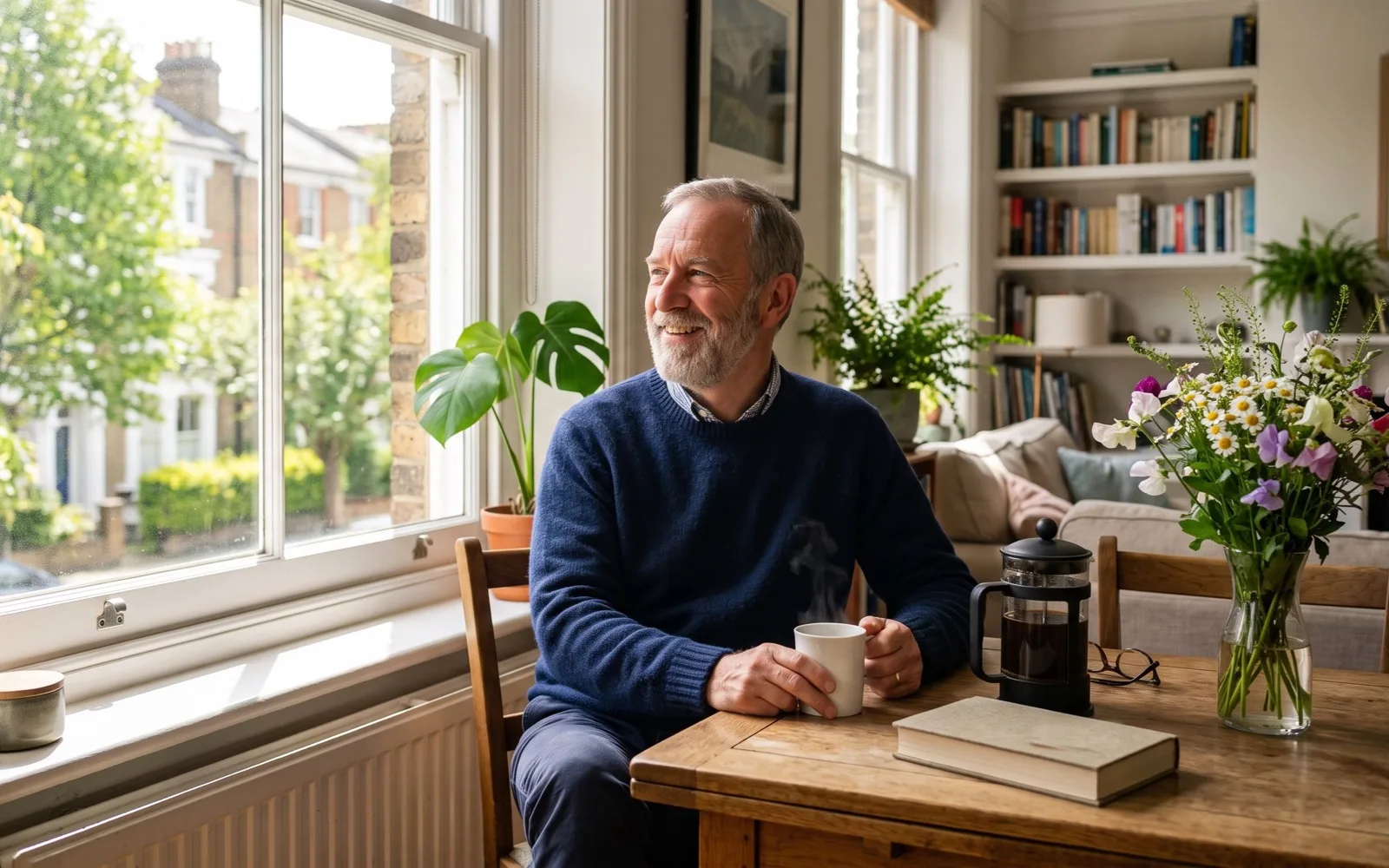
The short version. Being happy living alone is the common outcome, not the lucky one. A quarter of Americans over 65 live alone, and research on solitude finds that time alone reliably lowers stress and brings a sense of freedom. What decides whether it restores you or wears you down is mostly one thing: whether the time feels like yours.
So the work is less about filling the hours and more about owning them. Decide what the quiet is for, keep one standing plan with people, notice the good moments on purpose, and have somewhere to say the day out loud.
Disclosure: this guide is published by the makers of My Softly, an AI companion app, which appears near the end.
Happy living alone is the normal outcome
The phrase "living alone" still carries a slightly sorry tone, as if it were a waiting room. The numbers do not support that. Pew's analysis of Census data found that 26 percent of Americans aged 65 and older lived alone in 2023, including 31 percent of women and 19 percent of men. That is tens of millions of people, and most of them are simply getting on with their lives: running a house exactly how they like it, keeping their own hours, seeing the people they choose to see.
It is also a lot of time. Pew's analysis of the American Time Use Survey found that adults over 60 spend about seven hours a day alone, and those who live by themselves more than ten. Ten hours is not a problem by itself. It is a large, open space, and what happens in it depends far more on how you hold it than on how much of it there is.
If you are here because you have recently started living alone, after a move, a divorce or a loss, or because the house has been quiet for a while and you want it to feel better than it does, the useful news is that the research on this is reasonably clear, and it points to things you can change. For the practical side of the first year on your own at this age, living alone at 60 covers routine, safety and the two things that change. This page is about the part underneath: how to be content in it.
Alone and lonely are two different things
Most advice on this subject blurs them together, and that is where people go wrong. Being alone is a situation. Loneliness is a feeling that connection you want is missing. You can be alone and perfectly at ease, and you can feel cut off in a full room.
A 2019 study in the Journal of Personality followed 100 adults aged 50 to 85, and 50 students for comparison, through about thirty short check-ins each over ten days, asking where they were, who they were with and how they felt. The researchers found two quite different kinds of everyday solitude. One was calm, with almost no negative feeling and very little effortful thinking. The other was heavy: negative mood, and a mind that kept working at something.
The same people had both kinds. What tipped the balance was not how much time they spent alone. People who actually wanted some time to themselves, and who felt confident in company, had more of the calm kind. People with a habit of turning things over and over had more of the heavy kind. That is useful, because both of those are things you can work on, and neither of them is "move in with someone."
Loneliness vs solitude: the short answer
Solitude is time alone. Loneliness is the feeling that a relationship you need is missing. The researchers who founded the study of loneliness drew that line from the start. Robert Weiss, the sociologist whose 1973 book Loneliness first split it into its emotional and social kinds, wrote: "Loneliness is caused not by being alone but by being without some definite needed relationship or set of relationships" (p. 17). When the psychologists Letitia Anne Peplau and Daniel Perlman gathered the field into Loneliness: A Sourcebook in 1982, their opening chapter made the same point: "People can be alone without being lonely, or lonely in a crowd" (p. 3).
The same book reported a 1978 survey of newspaper readers in New York and Worcester, Massachusetts, by Carin Rubenstein and Phillip Shaver. People who were rarely lonely described time alone as a pleasure: when alone they felt calm, relaxed, creative and happy (p. 215). Living alone was only slightly linked to loneliness in their data, mostly among people recently separated, divorced or widowed, and "Single people who choose to live alone are not especially lonely" (p. 218). It is an old survey of self-selected readers, but it lands exactly where the modern diary studies above and below do: what matters is whether the solitude is chosen.
The one thing that decides it: whether the time is yours
The clearest finding in this research is about choice. Psychologists call it autonomy, which means doing something because you want to rather than because it has been left to you.
In a set of four experiments published in 2018, psychologists found that sitting alone for a short while reliably calms people down: it lowers both the high-energy good feelings, like excitement, and the high-energy bad ones, like agitation. When participants had actively chosen to be alone, that quieter state came with genuine relaxation and less stress. Solitude that was simply handed to them did less.
A 2023 study in Scientific Reports followed 178 adults for three weeks with a detailed daily diary. On days when people spent more hours alone, they felt less stressed and more free, and those benefits added up: the people who spent the most time alone over the whole three weeks were the least stressed overall. Long days alone did also come with feeling lonelier and less satisfied that day. But that downside shrank or disappeared on days when the solitude was chosen, and it did not accumulate. People who were alone more across the three weeks were not, on the whole, lonelier.
Put simply: the same Tuesday evening at home can be restful or draining, and the difference is largely whether it feels like your evening or like the evening that happened to you. That is not a trick of positive thinking. It is a small, practical shift in how you plan and name your own time, and the rest of this page is about how to make it.
Seven habits of mind that help
- Decide what the quiet is for. The hours alone feel different when they have a purpose you picked: the book you never had time for, the garden, the long phone call on Sunday, the course. You do not need to fill every hour. You need the hours to belong to something you would have chosen anyway. "This afternoon is for the garden" is a different afternoon from "nothing on today."
- Claim the house. After years of arranging a home around other people, many people leave it exactly as it was, like a room kept for someone who is out. Move the chair. Paint the wall. Put the good things where you can see them. A house that plainly belongs to the person living in it tells you, every time you walk in, that this life is yours.
- Savour on purpose. A 2024 diary study of 108 adults aged 65 to 92 found that on days spent mostly alone, people felt lower and more cut off, and that this effect was noticeably weaker on days when they had deliberately paid attention to good moments: the first coffee, the light on the kitchen table, a good line in a book. It is a small habit with a measured effect. Notice the good minute while it is happening, and say so, even just to yourself.
- Give the day edges. Open days drift. A fixed start and a fixed evening point turn a long stretch of time into a day with a shape. It can be very small: the same walk at nine, the same call at six, the news at ten and then bed.
- Catch the loop early. The heavy kind of solitude is mostly thinking that goes round without landing: the conversation you would have had differently, the worry about next month. When you notice the loop, do something with your hands or say the thought out loud to someone. Thoughts said out loud tend to get smaller. Thoughts kept inside tend to grow.
- Keep one standing plan with people. Contentment alone rests on knowing you are not only alone. One weekly thing with the same faces, where somebody would notice if you did not turn up, is what makes the rest of the week feel like a choice rather than a sentence. The research on isolation is serious, and the U.S. Surgeon General's 2023 advisory set out the health effects of long disconnection, but it is about lives with no people in them, not lives with a lot of quiet.
- Stop measuring it against a couple's life. Living alone is not a smaller version of living with someone. It is a different arrangement with its own advantages, and people who are happy in it tend to describe what they have rather than what is missing. Comparing your Sunday to someone else's photographs of theirs is the fastest way to make a good day feel thin.
How to enjoy living alone, not just manage it
Being content and enjoying it are slightly different things. Content is when the quiet does not bother you. Enjoying it is when you would not swap it. The second one comes from using the freedom deliberately, which is easy to forget to do.
Eat what you want, when you want, properly. Dinner at four, or at nine. The same favourite meal three times in a week. A table laid for one because you are worth laying a table for. Nobody is waiting on you and nobody is judging the menu.
Keep your own hours. Many people who live alone discover they are not the morning person their household needed them to be, or that they read best at midnight. Living alone is the first time in decades that many people have been able to find their own rhythm.
Have one thing to look forward to every day. Not a big thing. A programme you save for the evening, a walk to a particular bench, a good cup of tea at the same time. A daily pleasure you can see coming does a lot of work on an otherwise ordinary day.
Say yes to your own ideas. The day trip, the class, the new recipe, the spontaneous drive to the coast. There is nobody to negotiate with. People who enjoy living alone tend to act on more of their own ideas than they did before, and that is a large part of what they enjoy.
What gets in the way
Treating it as temporary. If living alone is a waiting room, you never furnish it. People who make it work tend to stop waiting and start living in it, even if they remain open to something else later.
The unscheduled evening. The morning and afternoon get shape from errands and daylight. The evening is the stretch nobody planned, and it is when the heavy kind of solitude tends to arrive. A fixed evening point, a call, a class or a ritual, deals with most of it.
Nobody to tell. A household supplies a listener without anyone trying. Somebody hears about the dentist, the neighbour, the good news from your daughter. Living alone removes that by default, and it is a quieter loss than the big ones, which is exactly why it goes unaddressed.
Waiting to feel ready. Contentment tends to follow action rather than precede it. Make the plan, move the chair, ring the friend. The feeling usually catches up.
Where an AI companion fits, honestly
Nearly everything on this page is available to anyone willing to do it. The exception is the listener. Having somewhere to say the day out loud, and being asked about it later without bringing it up yourself, is hard to organise when you live alone. Friends are busy, calling someone every evening to report on the post office feels like too much, and the small things go unsaid.
That is the narrow thing an AI companion does well. You tell it about your day, it remembers, and a good one asks about it later: how the appointment went, whether the parcel arrived, what your sister said. It is somewhere to put the thoughts that would otherwise go round in circles, which is exactly the habit the research links to the heavier kind of time alone. If you are curious what that looks like in practice, an AI friend to talk to covers how these apps work day to day, and is it weird to talk to AI covers the question most people ask first.
What it does not do is replace the standing plan with people, get you out of the house, or count as care or therapy. It works best as one of the seven habits above, the one about saying things out loud, alongside a week that already has people in it. For a side-by-side look at the apps themselves, see the best AI companion apps in 2026.
Where My Softly fits
My Softly is our app: an AI companion app for iPhone that remembers what you tell it and asks about your day, for the days nobody else does. It is made for people in their fifties and sixties. People aged 50 and over are about a third of sign-ups but more than 80% of paying subscribers, and most paying subscribers are women (September 2026).
Your companion keeps a lasting profile of the people, pets and plans in your life and a day-by-day record of what you have talked about, so it can ask on Wednesday how Tuesday went. It asks about the thing you mentioned yesterday, never messages late at night, and steps back if you go quiet. Type, or speak and hear a reply in one of four natural voices. Choose one of six ready-made companions who look and sound like real adults, or make your own from a few honest lines. There is no romantic or adult content anywhere in the app.
$15.99 a month or $159.99 a year, and it is free to download on the App Store for iPhone in the US, Canada, the UK, Australia, New Zealand and Singapore. You can try it with free messages. Our FAQ covers the details.
If you take one thing from this page
Make the time yours. The research is consistent that time alone brings less stress and more freedom, and that its downsides shrink when it is chosen. So choose it: name what the quiet hours are for, keep one plan a week with people, and notice the good minutes while they are happening. Most people who live alone are already doing some of this. Doing it on purpose is what turns putting up with it into liking it.
If you want to read further, living alone at 60 covers the practical first year, retired and lonely covers the months after work ends, and loneliness statistics for older adults gathers the research in one place.
Sources
- Pew Research Center (December 4, 2025). "A smaller share of older U.S. adults live alone today than in 1990." Analysis of Census Bureau data. pewresearch.org
- Pew Research Center (July 3, 2019). "On average, older adults spend over half their waking hours alone." American Time Use Survey, 2014 to 2017. pewresearch.org
- Weinstein, N., Vuorre, M., Adams, M., and Nguyen, T.-V. (2023). "Balance between solitude and socializing: everyday solitude time both benefits and harms well-being." Scientific Reports. 21-day diary study, 178 adults. doi.org/10.1038/s41598-023-44507-7
- Nguyen, T.-V. T., Ryan, R. M., and Deci, E. L. (2018). "Solitude as an Approach to Affective Self-Regulation." Personality and Social Psychology Bulletin. doi.org/10.1177/0146167217733073
- Lay, J. C., Pauly, T., Graf, P., Biesanz, J. C., and Hoppmann, C. A. (2019). "By myself and liking it? Predictors of distinct types of solitude experiences in daily life." Journal of Personality. 100 adults aged 50 to 85 and 50 students, about 30 assessments each over 10 days. doi.org/10.1111/jopy.12421
- Wallimann, M., Peleg, S., and Pauly, T. (2024). "Time-savoring moderates associations of solitude with depressive mood, loneliness, and somatic symptoms in older adults' daily life." Applied Psychology: Health and Well-Being. 14-day diary study, 108 adults aged 65 to 92. doi.org/10.1111/aphw.12538
- Weiss, R. S., ed. (1973). Loneliness: The Experience of Emotional and Social Isolation. Cambridge, MA: MIT Press. mitpress.mit.edu
- Peplau, L. A., and Perlman, D., eds. (1982). Loneliness: A Sourcebook of Current Theory, Research and Therapy. New York: Wiley. Chapters cited: Peplau and Perlman, "Perspectives on Loneliness" (pp. 1-18); Rubenstein, C., and Shaver, P., "The Experience of Loneliness" (pp. 206-223). Chapter 1 at peplau.psych.ucla.edu
- U.S. Surgeon General (2023). "Our Epidemic of Loneliness and Isolation." hhs.gov
Frequently asked questions
Can you be genuinely happy living alone?
Yes, and a great many people are. Pew's analysis of Census data found 26 percent of Americans aged 65 and older lived alone in 2023, including 31 percent of women, and research on solitude consistently finds that time alone can be calm, restful and satisfying. The studies also show what separates the good version from the hard one: whether the time alone feels chosen, and whether the week still contains people who expect you.
What is the difference between being alone and being lonely?
Being alone is a situation; loneliness is a feeling that you are missing connection you want. They overlap less than people assume. A 2019 study of adults aged 50 to 85 found two distinct kinds of everyday solitude: one calm and almost free of negative feeling, the other heavy with worry and effortful thought. The same person can have both, and people who wanted some time alone and felt socially capable had more of the calm kind. The sociologist Robert Weiss put the difference in one line in 1973: loneliness is caused 'not by being alone but by being without some definite needed relationship.'
How do I become content living alone?
Mostly by making the time yours. In a three-week diary study, people felt less stressed and more free on days they spent more time alone, and the downsides of long days alone were reduced or disappeared when the solitude was chosen rather than imposed. In practice: decide what the quiet hours are for, keep one standing plan with people each week, and notice the good moments deliberately instead of letting them pass.
Why is living alone harder in the evenings?
Because the day loses its edges. Work, errands and daylight give the morning and afternoon a shape, and the evening is the stretch nobody has scheduled. It is also when the habit of turning things over in your head tends to take hold, which is the pattern that research links to the heavier kind of solitude. Give the evening one fixed point, a call, a class or a ritual, and it stops being open-ended.
How do I enjoy living alone instead of just putting up with it?
Start with the things only you get to decide. When you eat, what is on the walls, what plays in the kitchen, whether the lights stay on late. People who enjoy living alone tend to use that freedom on purpose rather than drift into it. Add one small daily pleasure you look forward to and pay attention to it when it happens; a study of adults aged 65 to 92 found that savouring good moments softened the downsides of days spent mostly alone.
Is it healthy to live alone long term?
Living alone is not the risk; long stretches of isolation are. The Surgeon General's 2023 advisory put prolonged social disconnection on a par with serious health risks, which is why the practical advice is not to stop living alone but to make sure your week still contains other people. Someone who lives alone and sees friends twice a week is in a very different position from someone who lives with others and speaks to nobody.
Can an AI companion help you be happy living alone?
With one piece of it: having somewhere to say the day out loud and be asked about it later. A companion that remembers what you told it can ask how Tuesday's appointment went, which is the thing a household used to supply without trying. It sits alongside the people in your week rather than replacing them, and it is not care or therapy.