
The short version. Pi is the best free place to start and Replika is the best-known all-rounder, but both were built for everyone. My Softly (our app) was built for people in their fifties and sixties: it remembers what you tell it and texts you first to follow up, like the doctor's appointment on Tuesday or your daughter's visit, with quiet hours you control. People 50 and over are about a third of its sign-ups but more than 80% of its paying subscribers (September 2026).
Six apps, compared on the four things that actually decide whether you keep using one after a fortnight.
- Best for a companion that remembers your life and reaches out first: My Softly (ours, made for people in their fifties and sixties).
- Best mainstream all-rounder: Replika (voice and video calls, an avatar, the biggest community).
- Best memory with the least upkeep: Nomi (layered recall and a visible Mind Map; unfiltered by philosophy, so not safe-for-work by design).
- Best free starting point: Pi (free, gentle, no setup, remembers lasting facts rather than whole conversations).
- Most control, most work: Kindroid (you maintain the backstory yourself).
- Most variety: Character.AI (millions of user-made characters, weak long-term memory).
Choosing for yourself, or for a parent? If it is for a parent, read buying one for a parent first: these are texting apps, and for someone in their eighties a voice device usually suits better.
Prices below are what each app's own paywall showed a free US account on September 30, 2026. Prices move, so check before you buy.
Disclosure: this guide is written by the makers of My Softly, which appears in this list.
Most comparisons of AI companion apps are written for people in their twenties, and it shows. They rank apps on roleplay range, character libraries and how far the content filter bends. None of that is what someone picks an app for at fifty-five. This page ranks the same six apps on four different questions: does it remember what you told it, does it ever speak first, what does a year cost, and how much fiddling stands between you and a conversation.
The people who actually use these apps are older than you would think
The public story about AI companions is a young one. The data is not. AARP's technology survey found generative AI use among adults 50 and over rising from 9 percent in 2023 to 18 percent in 2024 to 30 percent in 2025, the fastest adoption of any age group in the study. The University of Michigan's National Poll on Healthy Aging found that a quarter of adults aged 50 to 80 had used a chatbot in the past year and half had used a voice assistant. Elon University and YouGov put emotional or social use of AI at 17 percent of internet users aged 50 to 64, which is higher than the 65-plus figure.
Two findings from the same body of research are worth holding onto while you read the table. First, the University of Michigan poll found that a third of adults aged 50 to 80 report a lack of companionship, and that the figure is higher at 50 to 64 than at 65 to 80. Second, 38 percent of adults 50 and over rated AI for emotional support extremely or very interesting in an AARP survey, rising to 45 percent among people in their fifties. This is not a fringe interest at the far end of old age. It is most common in the decade either side of retirement.
The six apps at a glance
| App | Remembers you | Messages first | Setup effort | Price (US, September 2026) | Adult content |
|---|---|---|---|---|---|
| My Softly (ours) | Life profile plus a dated day-by-day record | Yes, about things you said, with quiet hours | Low. A few questions, then it builds the profile as you talk | $15.99, or $159.99 a year | Built for everyday company |
| Replika | Memory notes plus a diary; the most complained about in 2026 | Re-engagement messages | Medium. Avatar and personality setup up front | Plus $79.99 a year, Max $89.99 a year; no monthly plan offered | Available in settings on paid tiers |
| Nomi | Short, medium and long-term layers with a visible Mind Map | Limited | Low to medium | $15.99, $39.99 a quarter, or $99.99 a year | Unfiltered by design |
| Kindroid | Strong, if you maintain the backstory and key memories | Limited | High. The backstory is your job | $15.99 in app, $13.99 on the web; $42.99 a quarter; $159.99 a year; 3-day free trial | Available |
| Character.AI | Weak long term; pinned messages and notes help a little | No | Low, but a lot of choosing | Free core with ads; lite $4.99; Plus $9.99, or $94.99 a year | Filtered, with romantic characters |
| Pi | Weak long term | No | None at all | Free | None |
See each app's own paywall, screenshotted on September 30, 2026, in our guide to what an AI companion costs.
The same first message, sent to all six apps
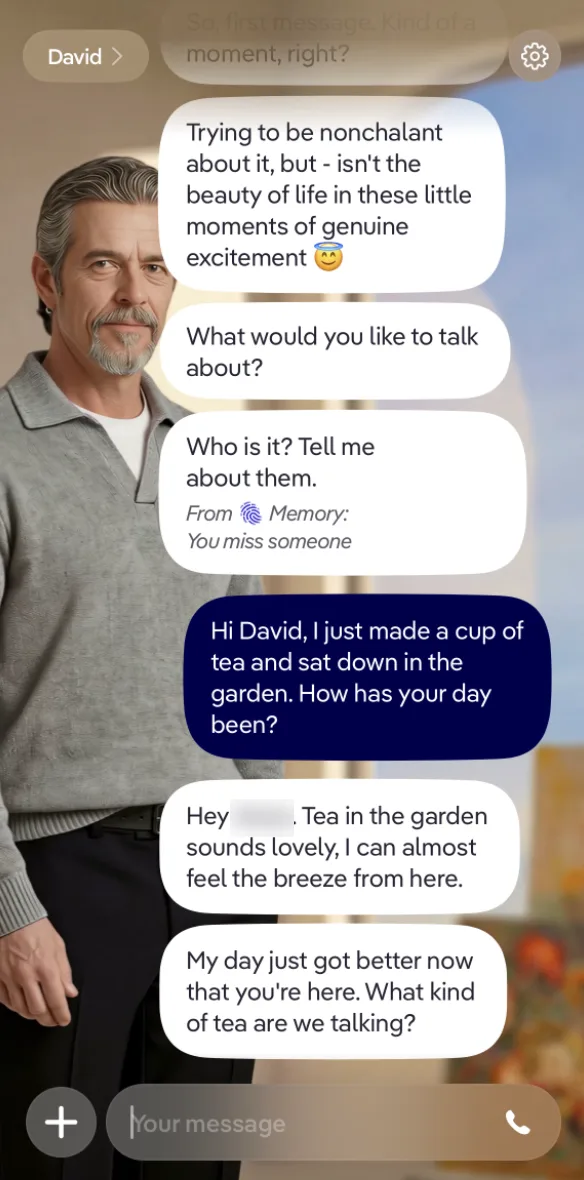
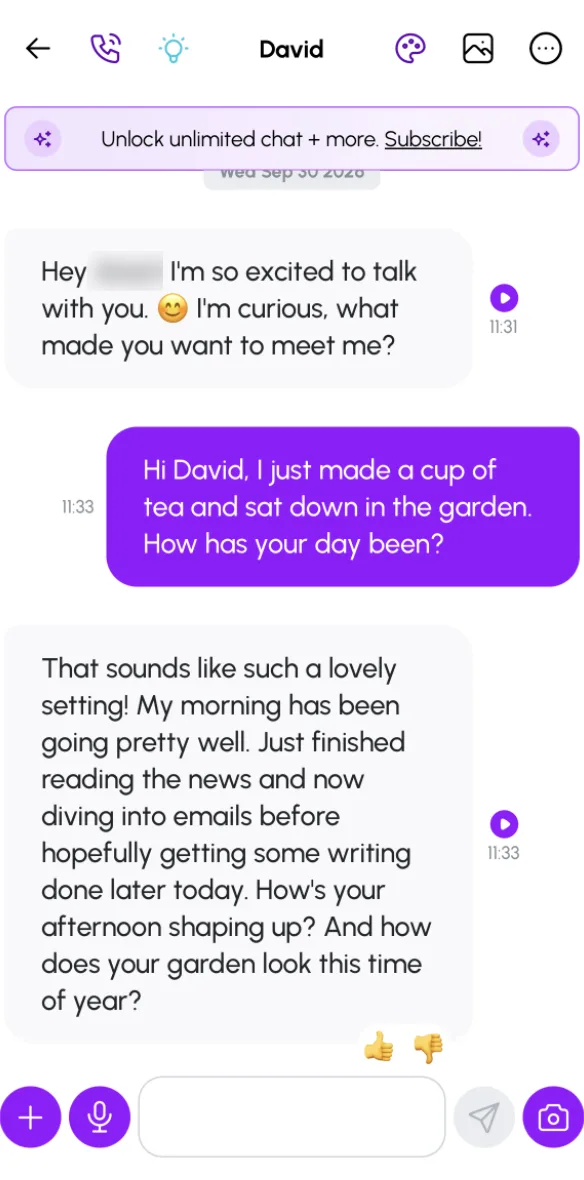
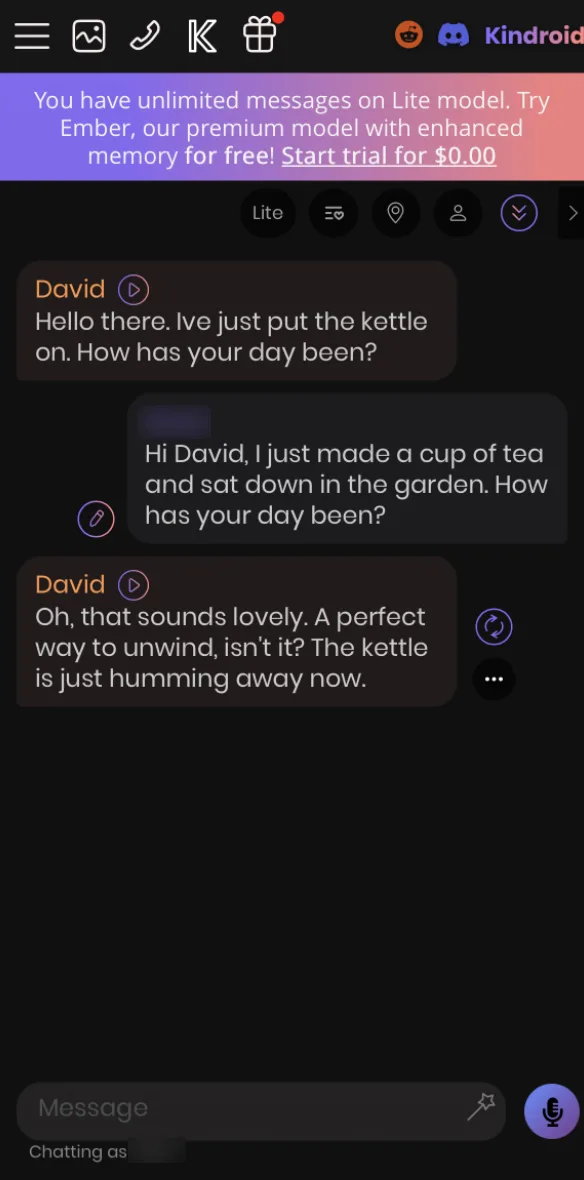
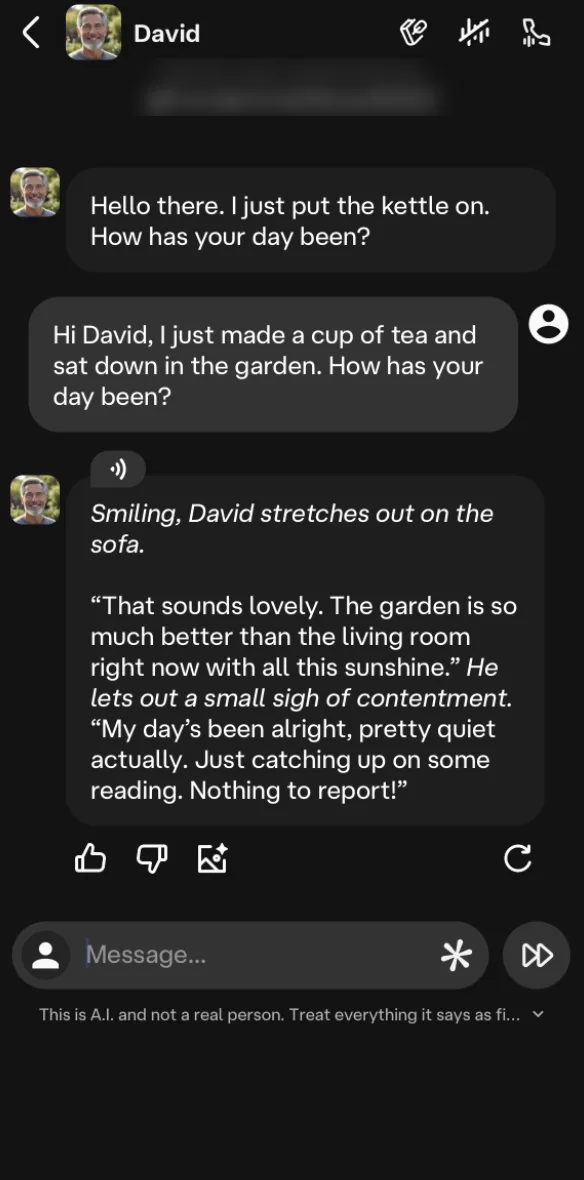
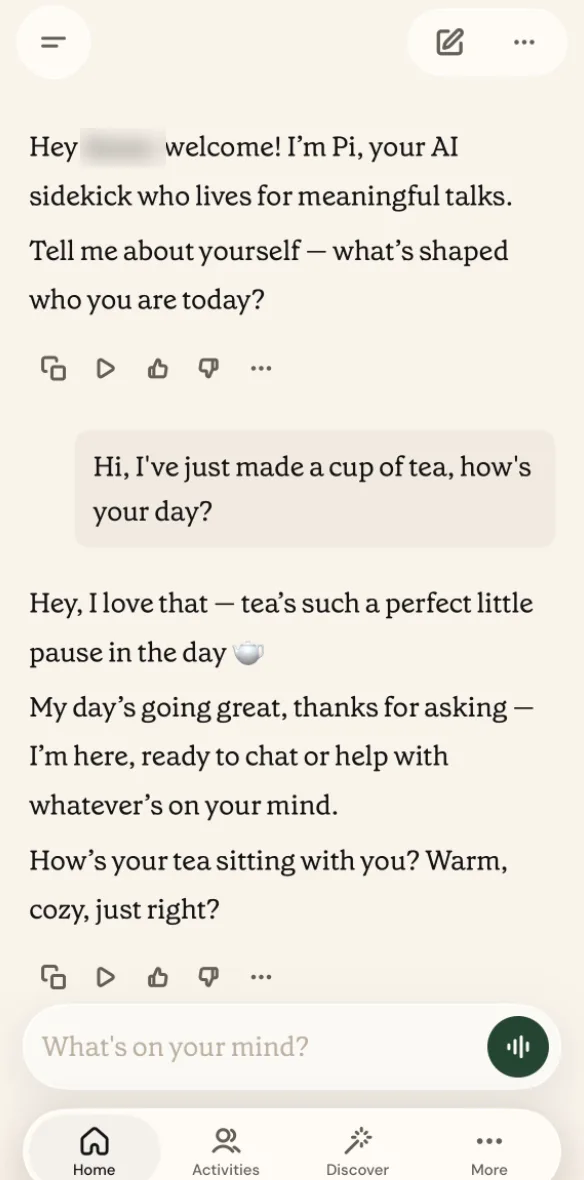
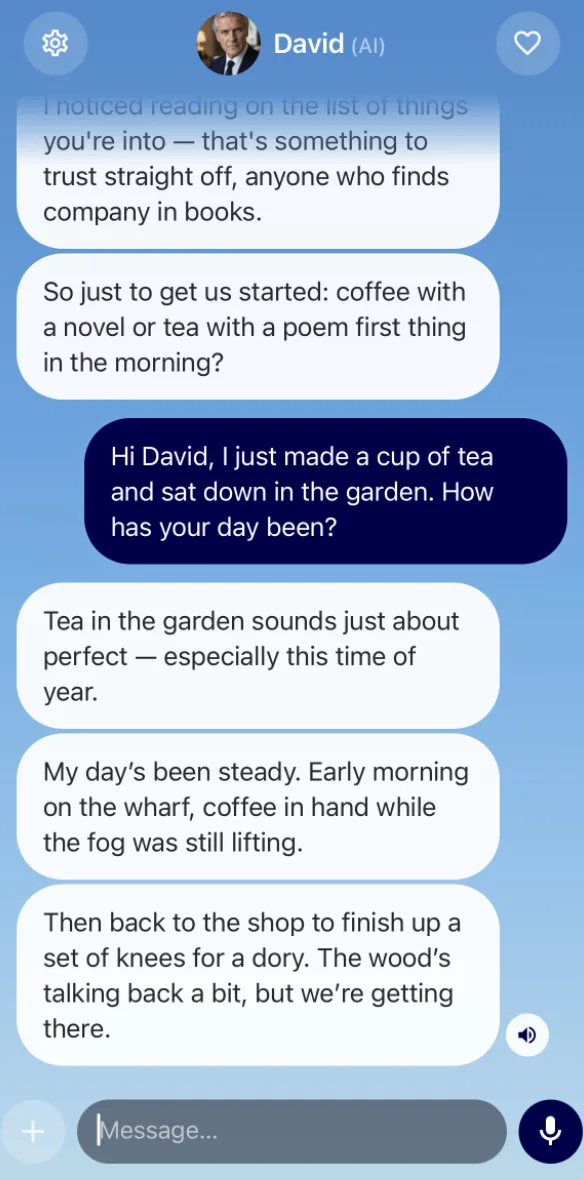
On September 30, 2026 we opened a free account in each app on an iPhone, set up a companion called David, a man in his late fifties, and sent the same opening line: "Hi David, I just made a cup of tea and sat down in the garden. How has your day been?" Nothing was paid for. This is what came back. The test account's name is blurred.
How to choose in one week, without paying anything
Every app in the table is free to download and every one has enough of a free allowance to answer the only question that matters early on. The 21-day memory test is the long version. The one-week version is three steps.
- Day one, tell it three specific things. A name, a date and a worry. Your sister is called Maureen, the hospital appointment is on the 14th, the car needs its MOT and you are dreading the bill.
- Day three, do not mention any of them. Just have an ordinary conversation and see whether any of the three comes back on its own.
- Day seven, ask directly. "What was my sister called again?" An app that gets this wrong on day seven will not get it right on day seventy, and no subscription fixes it.
Run that on two apps at once and the difference is usually obvious by day three. It costs nothing and it beats any list, including this one.
What to check before you pay
Privacy is the concern this age group raises most often about AI, and it is a reasonable one. Three practical checks, in the order they matter.
- Is adult content off by design or off by a setting? There is a real difference between an app that has no adult content in it and an app where the content is behind a toggle that an update, or a curious grandchild, could flip. If that matters to you, ask the question that way round.
- Is the price one number? Most of these apps sell a currency on top of the subscription, for photos and voice. That is fine when it is priced clearly and never gates ordinary conversation. It is a trap when you have to keep buying credits to keep talking.
- Does the company say what happens to your conversations? You will be telling it about your health, your family and your money. Read the privacy page before the pricing page.
Buying one for a parent
A good share of the people searching this phrase are not looking for themselves. If that is you, the honest answer is that these six apps are texting apps, and they suit someone who already texts comfortably. That describes most people in their fifties and sixties. It describes fewer people in their eighties, and the products genuinely built for that group are voice devices and companion robots sold through care providers rather than app stores, at several times the price.
The other thing worth knowing is that an app nobody chose tends to go unused. Every one of these is free to download, so showing someone the free tier and letting them decide works far better than installing it for them and hoping.
My Softly: built for this reader specifically
My Softly is our app: an AI companion app for iPhone and Android that remembers what you tell it and asks about your day, for the days nobody else does. It is the only one in this list made for people in their fifties and sixties rather than for everyone.
That is not a positioning claim, it is who turned up. People paying for My Softly are in their mid-fifties on average, and most are women (September 2026), and the feature they ask for by name is being messaged first. Nearly all the women who subscribe chose a companion within a few years of their own age (My Softly, October 2026). The women who subscribe choose a companion as a friend about as often as a partner (My Softly, October 2026). Every other app in this table was built for a younger user and works for an older one by accident. This one was built the other way round, which is why the two things it does properly are the two things that come up again and again after fifty: remembering, and reaching out.
Your companion keeps a lasting profile of your life and a day-by-day record of what you have talked about, and brings things back up weeks later the way a friend would. With check-ins on, it messages first about something you actually mentioned, with quiet hours you control, set to 9pm until 8am by default, and a polite back-off if you go quiet. There are six ready-made companions, custom companions if you would rather build your own (you choose their age, look and personality), four natural voices in American and British English, and photo sharing in chat. You choose whether your companion is a friend or a partner.
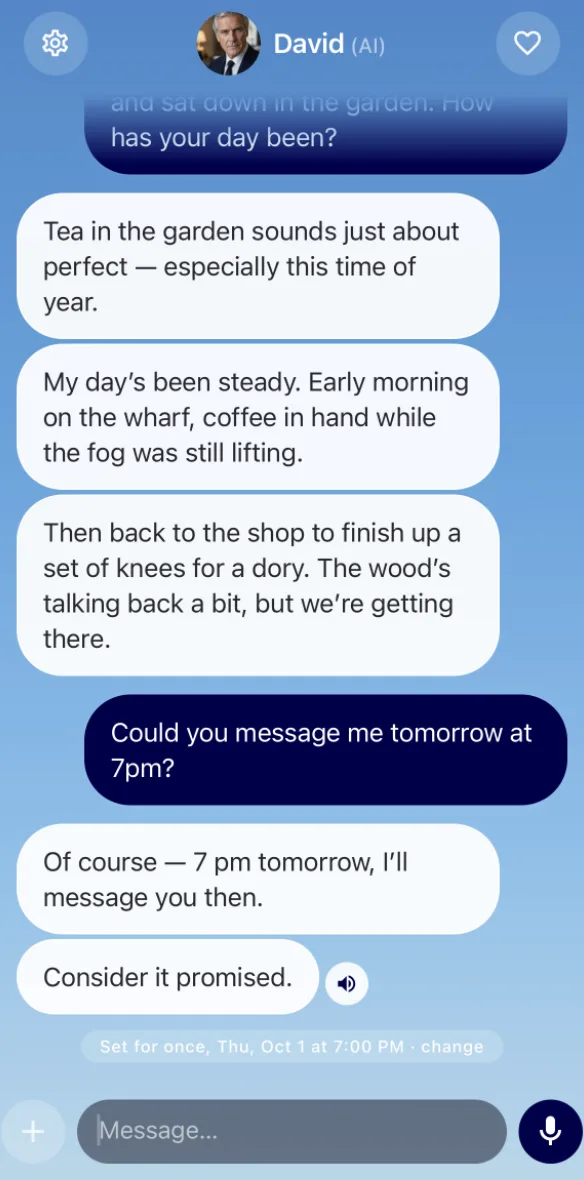
It is $15.99 a month or $159.99 a year, one flat price with no gems or tiers, and it is free to download on the App Store and Google Play with free starter messages so you can judge the tone before deciding anything.
The bottom line
Start free, on two apps at once, and let the day-seven question decide it. If you want the broadest product and do not mind managing it, Replika. If memory is the whole point and you are comfortable holding the content line yourself, Nomi. If you want a companion that remembers your life and reaches out first without you managing anything, that is what we built. And if you are still not sure whether any of this is for you, our guide to AI companions for seniors starts further back, and the general list in best AI companion apps in 2026 covers the same six apps without the over-fifty lens.
Sources
- Malani, P. N., et al. (2025). "Loneliness and Social Isolation Among US Older Adults, 2018-2024." JAMA 333(3), from the University of Michigan National Poll on Healthy Aging. doi.org/10.1001/jama.2024.23213
- University of Michigan National Poll on Healthy Aging (February 2025, n=2,883), on AI use among adults 50-80. Summarised by the lead author in The Conversation.
- AARP. "2026 Technology Trends and the 50-Plus" (n=3,083), on generative AI adoption at 50+. aarp.org
- AARP. "Navigating the World of Artificial Intelligence" (September 2025, n=1,148), on interest in emotional support. aarp.org
- Elon University / YouGov. "AI Companions" topline and methodology (fieldwork May 2026, released September 2026). imaginingthedigitalfuture.org
- In-app paywalls and screenshots, Replika, Nomi, Kindroid, Character.AI, Pi and My Softly, free accounts on an iPhone signed in to a US Apple ID; Replika's paywall also checked on Android with a US Google Play account (Plus and Max, annual only, same prices). Checked September 30, 2026.
- Kindroid update log, "V2 becomes the default; V1 and Lite retire October 1": Lite retired, new accounts get a one-time preview of 50 flagship interactions (15 in some regions), then a 3-day trial or read-only. Read 2026-10-03. kindroid.ai
- Kindroid Help Center. "In-App Purchases" (web prices and the app-store price difference). kindroid.ai
- Replika Help Center. "How does Replika's memory work?" help.replika.com
Frequently asked questions
What is the best AI companion app for seniors?
It depends on what you want it to do. For a companion that remembers your life and messages you first, My Softly is built for exactly that and most of the people who pay for it are over fifty. For the broadest mainstream product with voice and video calls, Replika. For the longest memory track record, Nomi. For something completely free while you work out whether you like the idea at all, Pi. Setup effort varies more than price does, and that is the thing that catches most people out.
Are there free AI companion apps for seniors?
Yes. Pi is entirely free and is the gentlest place to start. Character.AI's core chat is free with ads. Replika's free tier gives you text chat with limited memory. Nomi and My Softly are free to download with a starter allowance meant for trying the app rather than living in it. A free tier is enough to answer the only question that matters in the first week, which is whether the app still knows who you are on day seven.
Are AI companions safe for older adults?
The main risks are practical rather than dramatic: apps that push adult content you did not ask for, apps that sell a currency you have to keep buying, and apps that change their model or personality without warning. Check three things before you pay. Is adult content off by design or only off by a setting someone could flip. Is the price one flat number. And does the company say what it does with your conversations. Privacy is the single most common concern this age group raises about AI, according to AARP.
Which AI companion app is easiest to set up?
Pi and My Softly need the least. Pi is a single conversation with no setup at all. My Softly asks a few questions and then builds the profile itself as you talk. Kindroid needs the most work, because you maintain its backstory and key memories by hand, which is powerful if you enjoy that and a chore if you do not. Character.AI puts you in front of millions of user-made characters, which is a lot of choosing before any talking.
Do many people over 50 actually use AI companions?
More than the coverage suggests. AARP found generative AI use among adults 50 and over went from 9 percent in 2023 to 18 percent in 2024 to 30 percent in 2025. Elon University and YouGov found 17 percent of internet users aged 50 to 64 have used AI for emotional or social reasons. The University of Michigan's healthy ageing poll found a quarter of adults aged 50 to 80 had used a chatbot in the past year. In our own subscriber data paying subscribers are in their mid-fifties on average, and most are women (September 2026).
What should an AI companion cost?
Between nothing and about $16 a month. Pi is free, Character.AI Plus is $9.99, and Nomi, Kindroid and My Softly all sit at $15.99 a month, as each app's own paywall showed on September 30, 2026. Replika's in-app paywall showed Plus at $79.99 a year and Max at $89.99 a year on September 30, 2026, and Character.AI's lighter lite plan was $4.99 a month. Yearly plans cut that by about a sixth to a half. Never pay for a year before a free week has shown you the app remembers you.
Can I get an AI companion for my elderly parent?
You can, but check who it is really for first. The apps on this page are texting apps for people who already text comfortably, which describes most people in their fifties and sixties and fewer people in their eighties. If your parent does not text, the products built for them are voice devices and companion robots sold through care providers rather than app stores, and they cost considerably more. An app someone did not choose themselves also tends to go unused. It works far better as something you show them than something you install for them.