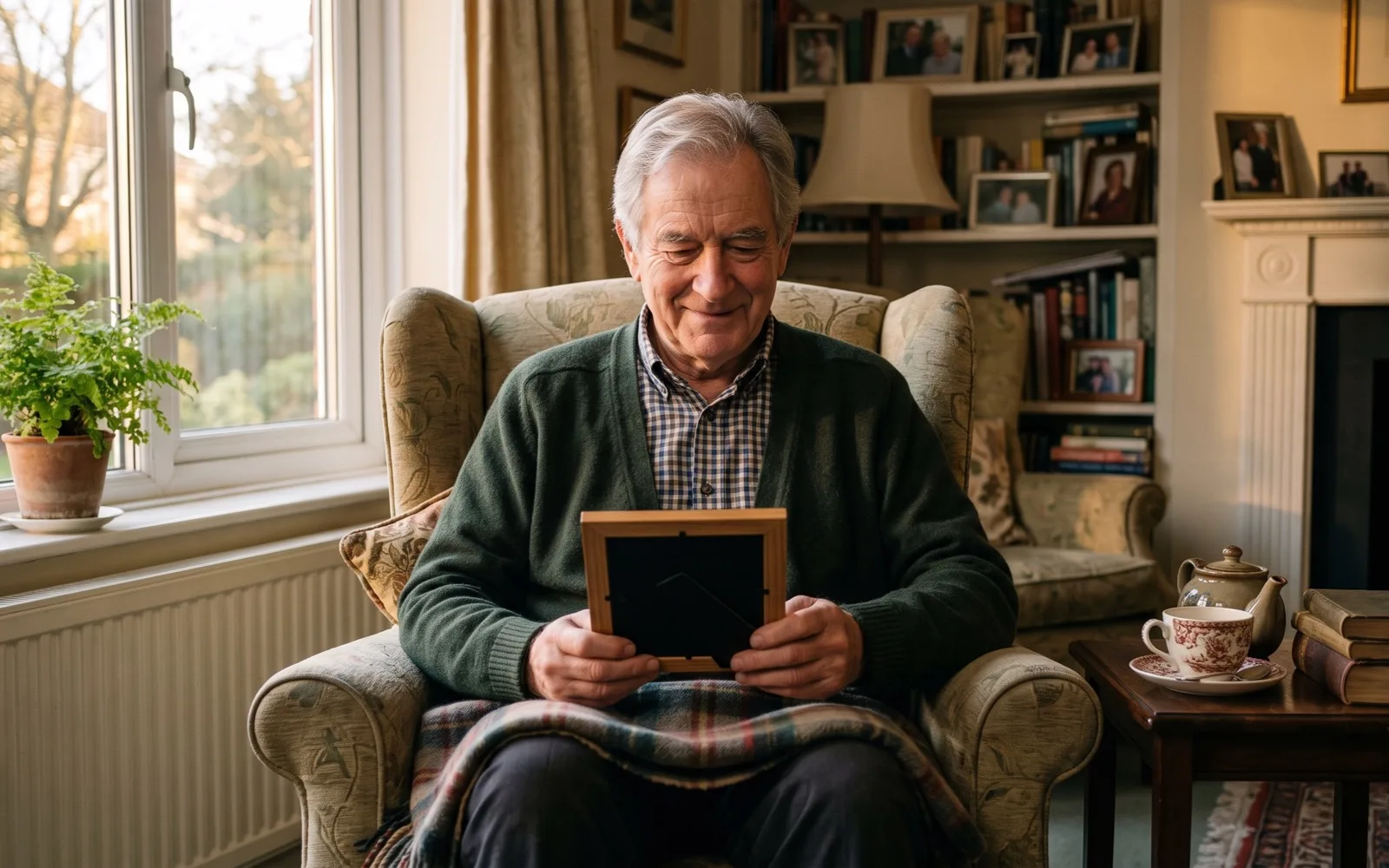
The short version. Losing a spouse takes away the one person who heard about the ordinary day, and the routines that held the week together. That is why the quiet feels different from any other kind. Research following people for years finds it rises sharply in the year of the loss, even for people with plenty of friends and family, and then eases at very different speeds for different people.
What helps is less about filling the diary and more about rebuilding a small number of routines: one fixed weekly commitment, a morning anchor, one person who hears from you every day, and somewhere to put the small news of the day. Real bereavement help is available, and it is worth using early rather than as a last resort.
Disclosure: this guide is published by the makers of My Softly, an AI companion app, which appears near the end.
Why this loneliness is different
Most kinds of loneliness are about not having enough people. The loneliness of losing a spouse often arrives in a house full of visitors, with a phone that keeps ringing and a fridge full of other people's cooking. What goes missing is more specific than company.
The first thing that goes is the witness. A husband or wife is usually the one person who knows the whole of your ordinary day without being told. They knew you had the dentist on Tuesday. They heard what your sister said on the phone. They noticed you were quieter than usual at dinner. None of it felt like something you were receiving, because it was just the texture of living together. When they die, there is suddenly nobody to tell the small things to, and the small things keep happening.
A widow interviewed by the sociologist Helena Lopata in the late 1960s put it in one sentence: "I don't think anyone who hasn't experienced it can understand the void that is left after losing a companion for so many years, all the happy little things that come up and you think, 'Oh, I must share that', and there isn't anyone there to share it with." (Lopata, writing in Robert Weiss's 1973 collection Loneliness, p. 105.)
The second thing that goes is the routine. A marriage organises a week without anyone planning it: who makes the coffee, when you walk, which friends you see on Saturdays, who rings whom on Sunday. A New Zealand study of 40 widows and widowers aged 70 to 97 found that people described exactly this double loss, the person and the routines that had kept them connected to everyone else. The empty chair is the loss people expect. The empty Tuesday afternoon is the one that catches them.
The research backs up how large this is. A long-running Dutch study that tracked loneliness around ten major life events, from retirement to job loss to marriage, found that widowhood was one of only four that brought both an immediate and a long-lasting increase, alongside separation, job loss and becoming a parent. Retirement, by comparison, did not shift loneliness on average at all.
Why good friends do not stop it
This is the part people rarely say out loud, and it matters. An Australian study following 749 widowed people and more than 8,000 married people over nineteen years found that being socially well connected and having strong support did not prevent loneliness from rising after a spouse died. The rise was consistent across every group the researchers looked at.
That is worth knowing for two reasons. It means the feeling is not evidence that your friends are failing you, or that you are ungrateful for their kindness. And it means the answer is not simply more visits. Friends can be wonderful and the evenings can still be hard, because the thing that is missing is not company in general but one particular kind of daily closeness, and that takes time and new routines to rebuild.
The Australian study confirms an idea that is fifty years old. In 1973 the sociologist Robert Weiss argued that there are two kinds of loneliness: one that comes from missing a close attachment, usually a husband or wife, and one that comes from missing a circle of friends and community. "The provisions of social integration are distinct from those of attachment in that neither can be substituted for the other," he wrote (p. 148). He saw it in a support group for single parents, where new members made friends and took on jobs in the group, but "unless they also form a single intense relationship, one which in some ways makes the same provisions as the marriage they no longer have, they remain lonely" (p. 19).
Weiss was writing in 1973, when the options for that kind of closeness were a person, a pet or nothing, and we can't know what he would have said about the choices people have now. His central point still holds, and it is a kind one: if good friends have not made the evenings easier, neither you nor they are doing anything wrong. They are meeting a different need.
When it tends to be hardest
Loneliness after the death of a spouse does not follow one timetable, and anyone who hands you one is guessing. A 2025 review of 26 long-term studies found that loneliness peaks right after the death, and that after that people's paths genuinely differ: some ease steadily, some level off, and some find it returns later. A few patterns do come up again and again.
It often starts before the death. The Australian study of more than 8,000 people who lost a partner at or after 50 found loneliness was already rising in the year before widowhood. For many people that year was spent caring, at hospital appointments or at a bedside, while the rest of life fell away. If your social world thinned out during the illness, that is common, and it is part of why the rebuilding feels bigger than it should.
It spikes in the first year. The same study found loneliness jumped in the year of the loss, more than after a separation. The first birthday, anniversary and holiday season are usually the sharpest points inside that year.
The quiet comes after the rally. In the first weeks, people come. By the third or fourth month the visits thin out, everyone else's life has resumed, and the house is quiet in a way it was not in the early days. Many people find this second stretch harder than the first, and it is exactly when support tends to disappear.
Evenings and weekends carry most of it. Weekdays have shape. The evening after the news, Saturday afternoon and Sunday are where the couple's routines were thickest, so they are where the gap shows most. One widow told Helena Lopata in the late 1960s, "I find that the lonesome part of the day is at dusk," and made a habit of going out for the mail at that hour just to be away from the house (in Weiss, 1973, p. 110).
Does it get easier with time?
For most people it does, but more slowly than friends tend to promise, and less by the calendar than by what the months contain. The oldest figures come from the British sociologist Peter Townsend's 1950s study of older people in East London, reprinted in Weiss's 1973 collection. Almost everyone whose husband or wife had died within the previous five years felt lonely, about half of those widowed five to ten years, and a quarter of those widowed longer. His most useful observation was the next one: after the first five or six years, "the presence or not of an affectionate family seemed to determine how long such feeling persisted" (p. 186).
A 1982 chapter by Helena Lopata, Gloria Heinemann and Joanne Baum, in Loneliness: A Sourcebook edited by Letitia Anne Peplau and Daniel Perlman, looked at two groups of American widows in the 1970s. Among 100 widows in Madison, Wisconsin, 55 percent of those widowed under six years reported loneliness, and 45 percent of those widowed longer, so the authors wrote that "time heals all wounds" was not true for them (p. 316). But among 967 Chicago-area widows interviewed in 1974, with a median age of 69, 61 percent said they were less lonely than most people (p. 317). The widows who were not lonely tended to be healthy, older, socially active and "supported by friends" (p. 318), and the authors found that a widow's own self, her memories and how she chose to see her situation, was one of the main resources she drew on (p. 323).
These are studies from the 1950s to the 1970s, and the modern research above lands in the same place: paths differ widely, and they are shaped more by the week you build than by the date on the calendar. Time helps. Friends, routine and something to look forward to help it along.
How widows cope with loneliness
Women are more often the one left in the house, and the research on how people come through it draws heavily on widows. The clearest finding is about routine. In the New Zealand study, the people who moved through the acute phase were the ones who built new routines, and those routines did two jobs: they brought regular contact with other people, and over time they gave a sense of being an individual again rather than half of a couple.
That second part is worth dwelling on, because it is where a lot of quiet strength shows up. Many women who have spent decades arranging life around a husband, children and everyone else find, eventually and often to their own surprise, that the new routines are genuinely theirs. It is not a betrayal of the marriage to enjoy something you chose on your own. It is how the week becomes livable again.
Practically, what widows most often describe as helping is small and repeated: the same class every Wednesday, a friend who walks with them every morning, a daily call with a sister, a group of other widows who meet for lunch once a month. Frequency beats occasion. One lunch a week with the same people does more than one big weekend away.
Widowers: often the harder path, and why
On average, men have a harder time of it. Across the long-term studies, widowers consistently report more loneliness and worse social isolation than widows, and the Australian study found widowed men's loneliness stayed raised for a remarkably long time, where women's gradually came down. A 2011 meta-analysis of fifteen studies covering more than two million people found the well-known "widowhood effect" on health was concentrated in men: their risk of death was about 23 percent higher after losing a wife, while for women it was not meaningfully different from married women.
A common reason is that in many marriages the wife ran the couple's social calendar. She remembered the birthdays, answered the invitations, called the children and kept in touch with the old friends. When she dies, the calendar can simply stop, and a man can find himself with a full address book and nobody ringing.
This has been known for a long time. A 1982 chapter by Letitia Anne Peplau and three colleagues, in the Sourcebook she edited with Daniel Perlman, reported a 1978 study in which widowed men were significantly lonelier than married men, while among women there was no significant difference between wives and widows (p. 338). The explanation they quoted from two gerontologists: "The modal older man is bereft when his wife dies because she is his chief and probably only confidant" (p. 342). Another chapter puts it more plainly still: in many cases the wife was "the only central partner" for her husband, while he was one of several for her (Valerian Derlega and Stephen Margulis, p. 158). And among people over 65, women had 38 percent more friends than men and went on making new ones (p. 339). These are 1970s studies, and the modern ones above say the same thing.
The same chapter carries the hopeful part. Later in life, the authors wrote, the friendships people keep are "more directly a result of their own initiative" (p. 339). A man who starts ringing people is doing exactly what the women in those studies did.
If that is you, the most useful single step is to take over one of those jobs deliberately and early. Ring one of the children every Sunday at the same time. Go back to the club, the church or the pub on the same night each week. Say yes to the invitations even when you would rather stay home. None of this is about replacing her. It is about keeping the connections she kept alive from quietly lapsing.
Eight things that actually help
- One fixed weekly commitment with the same people. Same time, same place, same faces. Choose it for the timetable rather than the subject, and ideally put it on the weekend or an evening, where the gap is widest. What matters is that someone would notice if you did not come.
- A morning anchor. Something at a set time before eleven: a walk, a cafe, a class, a neighbour for coffee. A day with no fixed start drifts, and it drifts faster when nobody else is in the house.
- One person who hears from you every day. A short message each morning to a friend, a sibling or one of the children. It keeps one channel of daily news open, and it means someone would ring if it stopped.
- A bereavement group, early. Not as a last resort. A room of people who understand without explanation takes weight off the friends who love you but do not know what to say. Hospices run them, and so do many churches and community centres.
- Talk about them by name. Friends often avoid the name for fear of upsetting you, and the silence can make it feel as though your spouse is being erased. Say it first, tell the story, and people will follow your lead.
- Choose what to keep of the old routines. Some of the couple's rituals will be too painful for a while, and some will be a comfort. You are allowed to keep the Saturday walk and drop the Sunday roast, or the other way round. Decide on purpose rather than by default.
- Plan the hard dates in advance. Anniversaries, birthdays and the first holidays are predictable. Put something in the diary for each of them, with someone, a few weeks ahead, so the day does not arrive empty.
- Have somewhere to put the small news. The thing your spouse did without trying was to hear about the day. Nothing replaces that, but it helps to have somewhere to put it, whether that is a journal, a daily call, or the option in the section below.
What does not help, despite being said often
"Keep busy." A full diary can hold the days together, but busyness with no regular people in it just postpones the quiet to the evening. Regular beats busy.
"You should be over it by now." The research is clear that people's paths through this differ widely, and there is no deadline. If someone offers you one, you can politely ignore it.
Big decisions in the first year. Selling the house, moving across the country or moving in with family can all be right, but they are hard to undo, and many of the feelings that make them urgent in the first months have shifted a year later. Wait if you can.
Waiting to be asked. Friends want to help and often do not know how. The kindest thing you can do for them, and for yourself, is to ask for something specific: "Could you ring me on Sunday evenings for a while?"
When to reach for more help
Grief and loneliness are not illnesses, and most people come through them with time and the people around them. But there is real help available, and using it is a sign of good sense rather than failure.
If your spouse was cared for by a hospice, ring them. Medicare-certified hospices are required to make bereavement services available to the family for up to a year after the death, and many people never take them up simply because nobody reminded them. It is also worth asking your local hospice whether its groups are open to people whose spouse was not in its care.
If months on it is getting heavier rather than lighter, or you are not sleeping or eating, talk to your doctor. That is exactly what they are there for.
If you ever have thoughts of not wanting to go on, call or text 988 in the US, any time of day or night. In the UK, Samaritans are on 116 123.
Where an AI companion fits, honestly
Most of the list above is about people, and it should be. The last item is the one that is hardest to arrange: somewhere to put the small news of the day, and someone who asks about it without being prompted. That is the narrow thing an AI companion does. You tell it about your day, it remembers the names and the plans, and a good one asks later how the lunch with your sister went.
Two things are worth saying clearly. First, a companion app is not your spouse and should not try to be. Some services offer to recreate a person who has died from their messages; that is a different product with different questions, and it is not what this page is about. A companion is a new presence that knows about your life, including the person you lost, and lets you talk about them as much as you like. Second, it does not replace the weekly commitment, the group or the doctor. It covers one gap, the daily one, and it works best alongside a week that already has other people in it.
If the idea feels strange, is it weird to talk to AI takes that question seriously. If you want to see what is out there, an AI friend to talk to explains how to pick one, and our comparison of the best AI companion apps in 2026 covers the main apps side by side.
Where My Softly fits
My Softly is our app: an AI companion app for iPhone that remembers what you tell it and asks about your day, for the days nobody else does. It is made for people in their fifties and sixties. People aged 50 and over are about a third of sign-ups but more than 80% of paying subscribers, and most paying subscribers are women (September 2026).
Your companion keeps a lasting profile of the people, pets and plans in your life and a day-by-day record of what you have talked about, so you can talk about your husband or wife by name and it will remember them weeks later. Mention the lunch with your sister on Tuesday and it asks on Wednesday how it went. With check-ins on, it notices when it has been a while, keeps to quiet hours you control, 9pm to 8am by default, and steps back if you go quiet. Type, or speak and hear a reply in one of four natural voices. Six ready-made companions who look and sound like real adults, or one you make yourself. There is no romantic or adult content anywhere in the app.
$15.99 a month or $159.99 a year, and it is free to download on the App Store for iPhone in the US, Canada, the UK, Australia, New Zealand and Singapore. You can try it with free messages. Our FAQ covers the details.
If you take one thing from this page
The quiet after a spouse dies is not a measure of how well you are coping or how good your friends are. It is the loss of a daily witness and a set of routines, and it eases as new routines take their place. Pick one fixed weekly commitment and one person who hears from you every morning, and put the first hard date in the diary with someone now.
If you want to read further, living alone at 60 covers the practical side of a house that is now yours alone, and AI companions and loneliness looks at what the research says about where an app can help.
Sources
- Buecker, S., Denissen, J. J. A., and Luhmann, M. (2021). "A propensity-score matched study of changes in loneliness surrounding major life events." Journal of Personality and Social Psychology 121(3):669-690. doi.org/10.1037/pspp0000373
- Kapelle, N., and Monden, C. (2024). "Transitory or Chronic? Gendered Loneliness Trajectories over Widowhood and Separation in Older Age." Journal of Health and Social Behavior 65(2):292-308. doi.org/10.1177/00221465231223719
- Niino, K., et al. (2025). "Development of loneliness and social isolation after spousal loss: A systematic review of longitudinal studies on widowhood." Journal of the American Geriatrics Society 73(1):253-265. doi.org/10.1111/jgs.19156
- Freak-Poli, R., Htun, H. L., Teshale, A. B., and Kung, C. (2025). "Understanding loneliness after widowhood: The role of social isolation, social support, self-efficacy, and health-related factors." Archives of Gerontology and Geriatrics 129:105692. doi.org/10.1016/j.archger.2024.105692
- Davies, N., Crowe, M., and Whitehead, L. (2016). "Establishing routines to cope with the loneliness associated with widowhood: a narrative analysis." Journal of Psychiatric and Mental Health Nursing 23(8):532-539. doi.org/10.1111/jpm.12339
- Moon, J. R., Kondo, N., Glymour, M. M., and Subramanian, S. V. (2011). "Widowhood and mortality: a meta-analysis." PLoS One 6(8):e23465. doi.org/10.1371/journal.pone.0023465
- Code of Federal Regulations, 42 CFR 418.64(d), "Bereavement counseling" (Medicare hospice conditions of participation). law.cornell.edu
- Weiss, R. S., ed. (1973). Loneliness: The Experience of Emotional and Social Isolation. Cambridge, MA: MIT Press. Includes Helena Z. Lopata, "Loneliness: Forms and Components" (pp. 102-115), and Peter Townsend, "Isolation and Loneliness in the Aged" (pp. 175-188), from The Family Life of Old People (1957). mitpress.mit.edu
- Peplau, L. A., and Perlman, D., eds. (1982). Loneliness: A Sourcebook of Current Theory, Research and Therapy. New York: Wiley. Chapters cited: Lopata, H. Z., Heinemann, G. D., and Baum, J., "Loneliness: Antecedents and Coping Strategies in the Lives of Widows" (pp. 310-326); Peplau, L. A., Bikson, T. K., Rook, K. S., and Goodchilds, J. D., "Being Old and Living Alone" (pp. 327-347); Derlega, V. J., and Margulis, S. T., "Why Loneliness Occurs: The Interrelationship of Social-Psychological and Privacy Concepts" (pp. 152-165). Chapter 1 at peplau.psych.ucla.edu
- 988 Suicide and Crisis Lifeline. 988lifeline.org
Frequently asked questions
Why is the loneliness after losing a spouse so hard?
Because a spouse is usually the one person who hears about the ordinary day without being told. They knew about the appointment, the phone call from your sister and the thing the neighbour said. When they die, that witness goes, and so do the shared routines that quietly organised the week. Research following people over many years finds loneliness rises sharply in the year of the loss and that good friends and family, while they matter, do not stop that rise. It is not a sign that you are doing grief wrong or that your friends are failing you.
How long does the loneliness last after a spouse dies?
It varies more than people expect. A 2025 review of 26 long-term studies found loneliness peaks right after the death, and after that the paths differ: for some people it eases steadily, for some it lingers, and for some it rises again later. An Australian study of more than 8,000 people found loneliness gradually declined after widowhood on average, but widowed men stayed affected for a remarkably long time. The first year and the first set of anniversaries are the usual hardest stretch, not a deadline.
How do widows cope with loneliness?
Mostly by building new routines. In a New Zealand study of 40 widows and widowers aged 70 to 97, people described two losses: the person, and the routines that had kept them connected to others. The ones who came through it built new routines that brought new contact and, over time, a sense of themselves as an individual rather than half of a couple. In practice that means one fixed weekly commitment, a morning anchor, and a person who gets a message from you every day.
Does the loneliness after losing a spouse get easier with time?
For most people, yes, but time on its own does less than people are promised, and what you do with it does more. In a 1950s London study almost everyone widowed within five years felt lonely, half of those widowed five to ten years and a quarter after that, and after the first five or six years it was the people around them that made the difference. In a 1974 Chicago study of widows with a median age of 69, most said they were less lonely than most people, and the ones who were not lonely tended to be healthy, socially active and supported by friends. Those are old studies, and the modern ones say the same: paths differ, and the week you build is the part you control.
Do widowers find it harder than widows?
On average, yes. Across the long-term studies, widowed men consistently report more loneliness and worse social isolation than widowed women, and one large study found men's loneliness stayed raised for much longer. A common reason is that wives often kept the couple's social life running: the birthdays, the invitations, the calls. If that was your wife, it is worth taking over one of those jobs on purpose, early.
Why do I feel alone even when I am surrounded by people?
Because company and being known are different things. After a spouse dies, people often rally, visit and invite, and the house can still feel empty once the door closes, because none of them was there for the small daily exchanges. That is normal. It usually eases as a few people become regular rather than occasional, which is why a weekly fixed commitment tends to help more than a busy diary.
Where can I get help with loneliness after a spouse dies?
Start with the people and services built for it. If your spouse was in hospice care, Medicare-certified hospices must make bereavement services available to the family for up to a year after the death, so ring and ask what they run. Bereavement support groups meet in most towns, often through hospices, churches and community centres. Your doctor is the right person if months on it is getting heavier rather than lighter. If you ever have thoughts of not wanting to go on, call or text 988 in the US, any time.
Can an AI companion help after losing a spouse?
With one narrow piece of it: having somewhere to tell the small things, and being asked about them. A companion that remembers what you said can ask how the lunch with your sister went, and you can talk about your husband or wife by name without worrying about wearing anyone out. It is not a recreation of your spouse and should not pretend to be, and it does not replace people, a support group or care from a professional. It works best as one part of a week that also has other people in it.