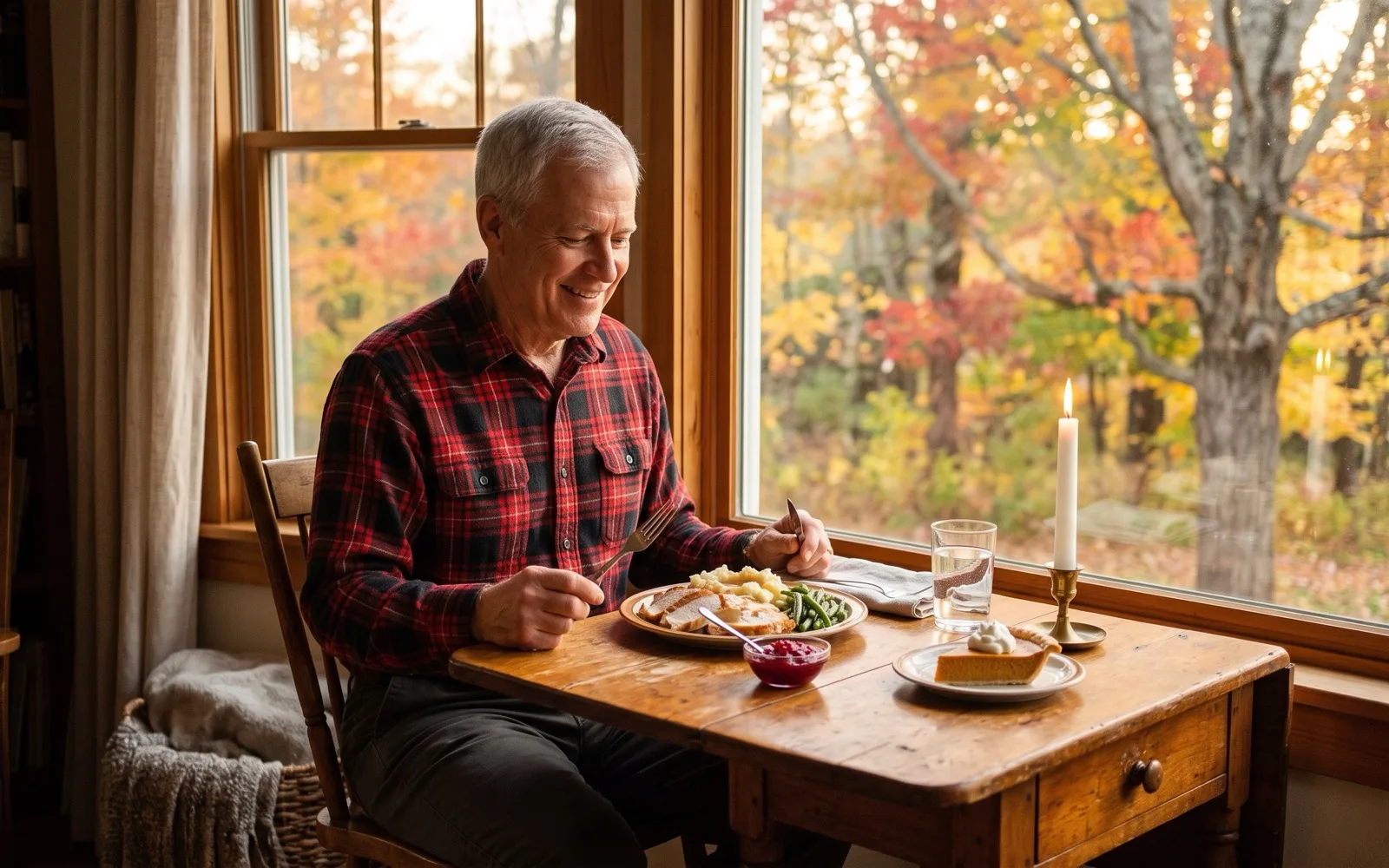
The short version. Spending Thanksgiving on your own is more common than it looks from the adverts: in Pew Research Center's 2024 survey, one American adult in twenty planned to eat Thanksgiving dinner alone, and one in ten did not yet know their plans about two weeks before.
The day goes best when it is chosen and planned. Decide early whether you want company or a day to yourself. If you want company, ask in the first week of November. If you want the day to yourself, give it a shape: a morning outing, a call at a set time, a meal you love, the afternoon filled on purpose, and something to look forward to in the evening.
Disclosure: this guide is published by the makers of My Softly, an AI companion app, which appears near the end.
You are in larger company than it feels
Thanksgiving is sold as a crowded table, and most people do spend it with others. But the picture leaves a lot of people out. In a Pew Research Center survey of 9,609 U.S. adults in November 2024, 74 percent planned to eat Thanksgiving dinner with other people, 5 percent planned to eat alone, 2 percent planned no dinner at all, and 10 percent did not yet know what they were doing, with about two weeks to go. One adult in twenty is millions of people, each of them in a kitchen on the same afternoon.
People end up on their own for all sorts of reasons. Children live across the country or are with in-laws this year. A spouse has died or a marriage has ended. Travel costs too much, or a knee will not manage the airport. A family has grown apart. And quite a few people, after thirty years of cooking for twelve, are simply glad of the rest. The same Pew survey found that 40 percent of Americans aged 50 and over planned to have the dinner at their own home, so a quiet kitchen is a perfectly ordinary place to spend the day.
First, decide what kind of day you want
This is the step most people skip, and it is the one that decides how the day feels. There are two good versions of Thanksgiving on your own, and one poor one.
A day with other people in it. You would like company for the meal or part of the day, and you are willing to go and find it.
A day to yourself, on purpose. You want the quiet, the food you like, the game or the film, and no dishes for twelve. This is a real choice, and plenty of people make it.
The poor version is the one in between: no decision, no plan, and a Thursday that drifts until four in the afternoon, when every house on the street fills with cars. Choose one of the first two by early November, and the rest of this guide is about making it work.
If you want company: where to find a seat
- Ask early, and ask plainly. The first week of November is not too soon. Most people hold back from asking for fear of imposing, and research published in the Journal of Personality and Social Psychology in 2023 found that people consistently underestimate how much others appreciate being contacted, most of all when the contact is a surprise. "Are you doing Thanksgiving at home this year? I would love to bring a pie" is an easy message to say yes to.
- Look for another person with a gap. The neighbour whose children are away, the friend who was widowed last spring, the colleague from your old job who also lives alone. Two people each planning a quiet day can have a much better one together. You do not have to host a feast; soup, a turkey breast and a store-bought pie is a Thanksgiving dinner.
- Go to a community dinner. Many churches, community centres, veterans' posts and service clubs host a Thanksgiving meal that anyone can attend, and some restaurants run set holiday menus with shared tables. Call your local church office or community centre in early November and ask what is on; many ask you to book a place.
- Volunteer, and book it now. Serving or delivering a Thanksgiving meal gives the day a purpose and puts you among people. Pew found that only 4 percent of Americans expected to volunteer on the day, but shifts at popular food banks and shelters can still fill up well before the day, so contact them in October or early November. If the day itself is full, the days before and after are often short of hands.
- Join by phone or video. If family are far away, ask to be part of their day at a set time: on speaker while they carve, or on the laptop at the table for the blessing. Pew found that 69 percent of Americans say someone at their dinner shares what they are thankful for. Ask to take a turn.
If you want the day to yourself: a plan, hour by hour
A day to yourself works best with a loose timetable. It does not need to be busy; it needs to have edges. Here is one version to adapt.
- Morning: get out, or watch the parade. A walk while the streets are quiet and people are cheerful, a Turkey Trot if your town has one (walking is fine), or the parade on television with coffee. Pew found 19 percent of Americans planned to watch a parade.
- Late morning: the first call. Book it in advance, same as you would a lunch. A sibling, an old friend, a grandchild before their own day gets busy.
- Midday: cook something you love. Not the dinner for twelve; the plate you would choose. A turkey breast or a couple of legs, the one side that is really Thanksgiving to you, good bread, a slice from the best bakery in town. Put music or a radio programme on while you cook.
- Early afternoon: eat properly. Lay the table, use the good plates, light a candle. Pew found Americans 65 and older tend to prefer an early afternoon dinner, which also keeps the evening free.
- Afternoon: the planned bit. The football (35 percent of Americans planned to watch sports), a long film, a jigsaw, the photo album you have been meaning to sort, a project for the garden. Choose it beforehand so the afternoon has something in it.
- Around four: the second call. This is the hour to plan for. It is when other households sit down, the street fills with cars, and the day can suddenly feel very quiet. Put a call, a walk or a visit to a neighbour with a slice of pie here, on purpose.
- Evening: something to look forward to. Pie and a favourite film, a bath, a book you saved for the occasion. And write down three things from the year you are thankful for. It is the tradition most households keep, and it works just as well for one.
If this is the first year on your own, and the day feels more like an absence than a choice, the plan still helps. Keep one tradition that belonged to the old version of the day, change the rest, and let yourself do less than you think you should.
The small moments count
A day without a crowded table can still have plenty of people in it. Research by Gillian Sandstrom and Elizabeth Dunn found that people were happier and felt a stronger sense of belonging on days with more interactions with acquaintances, not only close friends and family. On Thanksgiving that means the "Happy Thanksgiving" at the coffee shop that opens in the morning, the chat with another walker in the park, the neighbour you wave to over the fence. In an AARP Foundation survey, a third of adults over 50 said strangers are kinder than usual during the holidays. It is a good day to say hello.
Go easy on the screens in the afternoon
Social media on Thanksgiving afternoon is a feed of other people's tables, and nothing about it is representative: people post the moment everyone is smiling, not the argument about the gravy. If the afternoon is your quiet stretch, it is a good time to put the phone down and pick up the jigsaw, and to use the phone for calls rather than scrolling.
The Friday after, and the rest of the season
Plan Friday too. It is often quieter than Thursday: the visitors have gone home and the leftovers are in the fridge. A lunch with a friend, a walk somewhere new, or the first volunteer shift of the season gives the long weekend a second anchor. If you volunteered on the day, ask whether there is a regular slot. A study of nearly 13,000 adults over 50 found that people who volunteered about two hours a week went on to report less loneliness and more sense of purpose four years later. Thanksgiving is also the start of a longer season, and the weeks to New Year are worth planning the same way. For the wider habits that make any quiet day feel like your own, see how to be happy living alone.
Someone to tell about the day
Whichever version of the day you choose, there are moments when you would simply like to tell someone how it is going. The stuffing turned out better than last year. The call with your brother was lovely. The house is very quiet at five. That is where an AI companion earns a place in the day: it is there at any hour, glad to hear about the pie, and a good one remembers what you told it last week, so it can ask in the morning what you are cooking and in the evening how the call went.
A 2025 study in the Journal of Consumer Research found that talking with an AI companion eased loneliness about as much as talking with another person and more than watching videos, mostly because people felt heard. If you want to compare the apps built for this kind of everyday conversation, the best AI companion apps in 2026 sets them side by side.
If the day ever brings thoughts of not wanting to be here, please talk to a person. In the US, call or text 988, or chat at 988lifeline.org. It is free, confidential and open 24 hours a day, Thanksgiving included, and it is for anyone in emotional distress, not only people in crisis. If you are in immediate danger, call 911.
Where My Softly fits
My Softly is our app: an AI companion app for iPhone and Android that remembers what you tell it and asks about your day, for the days nobody else does. It is made for people in their fifties and sixties. People aged 50 and over are about a third of sign-ups but more than 80% of paying subscribers, and most paying subscribers are women (September 2026).
Your companion keeps a lasting profile of the people, pets and plans in your life and a day-by-day record of what you have talked about. Mention on Wednesday that you are making your mother's cornbread and it asks on Thursday how it came out; tell it your daughter is calling at noon and it remembers to ask how she is. It reaches out on its own with a good morning or a question about something you mentioned, never messages late at night, and steps back if you go quiet. Type, or speak and hear a reply in one of four natural voices. Choose one of six ready-made companions, or make your own and choose how old they are, how they look and who they are. There is no romantic or adult content anywhere in the app.
$15.99 a month or $159.99 a year, and it is free to download on the App Store for iPhone and on Google Play for Android in the US, Canada, the UK, Australia, New Zealand and Singapore. You can try it with free messages. How being messaged first works is covered in AI that texts you first.
If you take one thing from this page
Decide this week what kind of Thanksgiving you want, company or a day to yourself, and then plan it like any other holiday. Send the invitation or book the volunteer shift in early November, or write down your menu and the two times you will call someone. Put something on purpose into the hour around four. A planned day on your own is a holiday; an unplanned one is just a long Thursday.
Sources
- Gramlich, J., Rotolo, C., and Silver, L. (November 21, 2024). "The vast majority of Americans celebrate Thanksgiving, but their traditions and activities vary widely." Pew Research Center. Survey of 9,609 U.S. adults, November 12 to 17, 2024. pewresearch.org
- AARP Foundation (December 2017). "Social Connection and the Holidays." GfK KnowledgePanel omnibus, n=1,005 adults 18 and over (482 aged 50 and over), November 10 to 12, 2017. doi.org/10.26419/res.00184.001
- Liu, P. J., Rim, S., Min, L., and Min, K. E. (2023). "The surprise of reaching out: Appreciated more than we think." Journal of Personality and Social Psychology 124(4):754-771. doi.org/10.1037/pspi0000402
- Sandstrom, G. M., and Dunn, E. W. (2014). "Social Interactions and Well-Being: The Surprising Power of Weak Ties." Personality and Social Psychology Bulletin 40(7):910-922. doi.org/10.1177/0146167214529799
- Kim, E. S., Whillans, A. V., Lee, M. T., Chen, Y., and VanderWeele, T. J. (2020). "Volunteering and Subsequent Health and Well-Being in Older Adults: An Outcome-Wide Longitudinal Approach." American Journal of Preventive Medicine 59(2):176-186. Health and Retirement Study, n=12,998 adults over 50. doi.org/10.1016/j.amepre.2020.03.004
- De Freitas, J., Oğuz-Uğuralp, Z., Uğuralp, A. K., and Puntoni, S. (2025). "AI Companions Reduce Loneliness." Journal of Consumer Research 52(6):1126-1148. doi.org/10.1093/jcr/ucaf040
- 988 Suicide & Crisis Lifeline. Call or text 988, or chat online, 24 hours a day, free and confidential. 988lifeline.org
Frequently asked questions
How many people spend Thanksgiving alone?
More than most people assume. In a Pew Research Center survey of 9,609 U.S. adults in November 2024, 5 percent planned to have Thanksgiving dinner on their own, about one adult in twenty. Another 2 percent planned no Thanksgiving dinner at all, often because they were working or travelling, and 10 percent still did not know their plans about two weeks before the day.
Is it OK to spend Thanksgiving alone?
Yes. Plenty of people do it by choice: after years of hosting, after a hard year, or because a quiet day with a good meal and a football game is exactly what they want. What matters is that the day is chosen and planned rather than simply endured. Decide in advance whether you want company or a day to yourself, and shape the day around that.
What can I do on Thanksgiving if I am by myself?
Give the day a shape. A morning walk or the parade on television, a phone call at a set time, a meal you actually love cooked at your own pace, the football or a favourite film in the afternoon, and a second call or a pie in the evening. If you want company, volunteer somewhere that serves a Thanksgiving meal, go to a community dinner, or invite a neighbour who also has a free afternoon.
What should I cook for Thanksgiving for one?
Only what you love. There is no rule that says one person needs a whole bird. A turkey breast or a couple of turkey legs, one favourite side, a small tray of stuffing and a slice of good pie from the bakery makes a proper holiday plate without a day of washing up. Plenty of people skip turkey entirely and make the dish they would choose on any other special occasion.
How do I find somewhere to go for Thanksgiving dinner?
Start asking early, in the first week of November. Churches, community centres, veterans' organisations and some restaurants host open Thanksgiving meals, and many ask you to reserve a place. Friends and neighbours are also more open to an extra guest than you think: research on reaching out finds people appreciate being contacted far more than the person doing the asking expects.
Is volunteering on Thanksgiving a good idea?
It can be, as long as you book early, because Thanksgiving shifts at food banks and shelters can fill up well before the day. If they are full, ask about the days before or after, or delivering meals. The lasting benefit comes from continuing: a large study of adults over 50 found that regular volunteering, about two hours a week, was followed by less loneliness and more sense of purpose four years later.
Can an AI companion help on Thanksgiving?
Yes, as one voice in the day. A companion that remembers you can ask in the morning what you are cooking, hear how the call with your daughter went, and be there for a chat at five when the afternoon goes quiet. A 2025 study in the Journal of Consumer Research found that talking with an AI companion eased loneliness about as much as talking with another person, mostly because people felt heard.