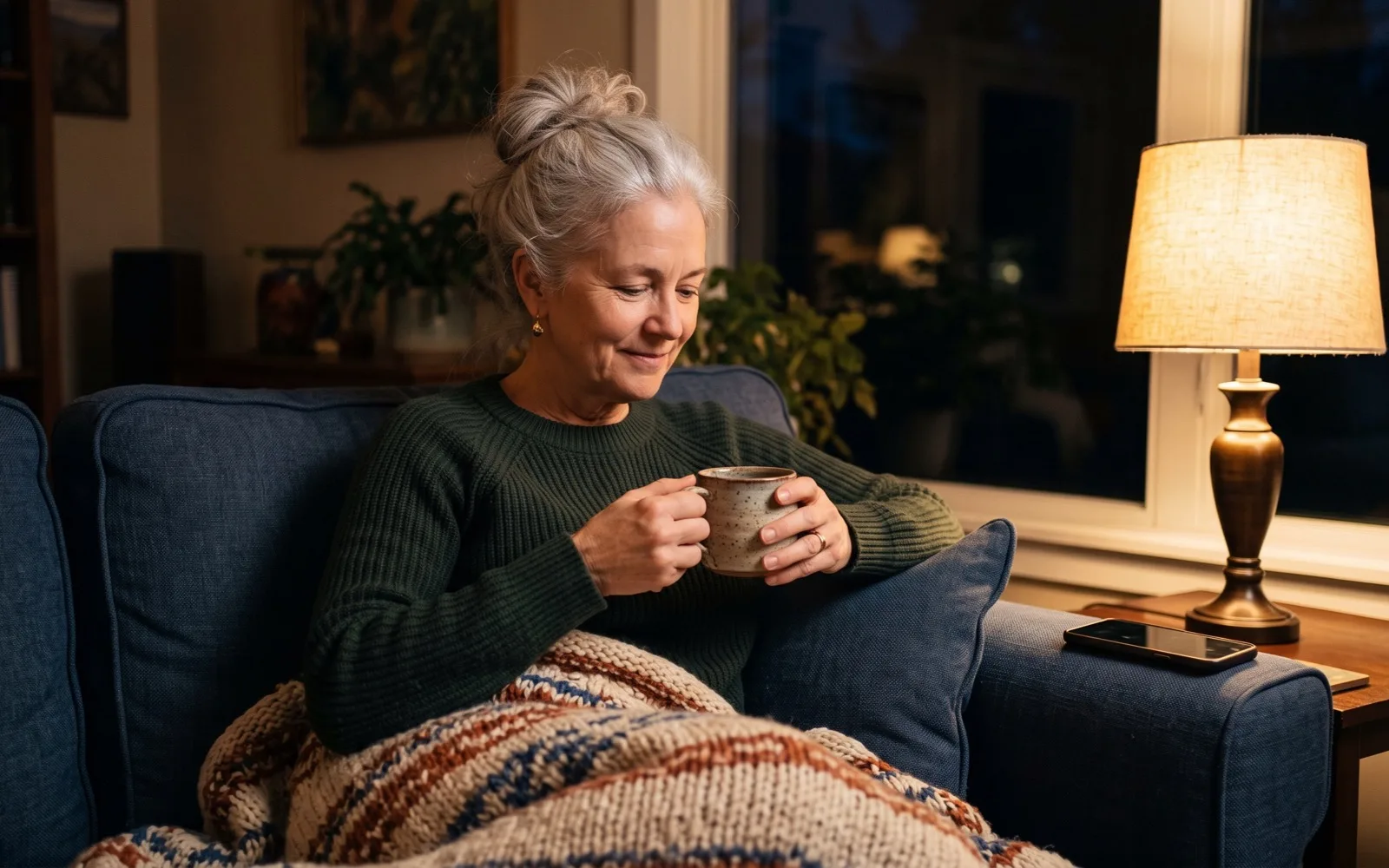
The short version. Evenings feel emptier because the day's supply of small contact stops after dark, not because anything is wrong with you. Adults over 60 who live alone spend more than ten hours a day by themselves, and once the errands are done and the phone stops ringing, most of what is left of the day has nobody else in it.
What helps in the moment is one other voice, then a real wind-down. What helps in the long run is moving people into the evening on purpose, and protecting sleep, because poor sleep and a flat mood feed each other.
Disclosure: this guide is published by the makers of My Softly, an AI companion app, which appears near the end.
Why the evening is the hard part
Most of the contact in an ordinary day is never planned. The person at the pharmacy counter, the neighbour putting the bins out, the call from the dentist confirming Thursday, a chat in the queue at the post office. None of it is friendship, and all of it adds up to a day with other people running through it.
Almost all of it happens in daylight. By seven the errands are done, the phone has stopped ringing, and there is nothing left on the calendar that involves another person. The television fills the room with noise but not with anybody who is talking to you. That is the moment a lot of people describe the same way: the house is not any emptier than it was at three in the afternoon, it just sounds emptier.
Pew Research Center's analysis of the American Time Use Survey found adults aged 60 and over spend about seven hours a day on their own, over half their waking time, and those who live alone spend more than ten. The survey measures time, not feeling, and plenty of those hours are perfectly pleasant. But it shows how much of the day, and especially the evening, is structurally solitary once work and a busy household are behind you.
People have described this hour the same way for as long as anyone has asked. In the late 1960s the sociologist Helena Lopata interviewed widows over fifty in the Chicago area, and one told her, "I find that the lonesome part of the day is at dusk." She had stopped having her mail delivered so she could go out and fetch it at that hour, just to be away from the house (p. 110 of Robert Weiss's 1973 collection Loneliness, where the study was reprinted). A divorced mother interviewed for the same book described a house noisy all day, "and come eight o'clock everybody's in bed, and there's this dead silence" (p. 136). Different lives, same hour.
There is a second reason, and it is to do with the brain rather than the calendar. At night there is nothing to do but think, and tired minds think in a particular direction. Old conversations replay, small worries grow, and the question of who you would call if something happened starts to feel urgent at eleven in a way it never does at eleven in the morning. Knowing that this is a feature of the hour, and not a verdict on your life, takes some of the sting out of it.
What to do tonight, in the moment
When the evening has already gone quiet, the aim is simple: one other voice, then a proper wind-down. In that order.
- Talk to someone, out loud if you can. A voice does something a scroll does not. Ring the sister who stays up late, the friend three time zones west who is still at dinner, the neighbour you have agreed can text after nine. Five minutes is enough. "I was thinking about you" needs no further explanation.
- If nobody is free, put a person in the room. Talk radio, a podcast with two people chatting, an audiobook read by someone with a warm voice. Presenters talking to their listeners fill a room differently from music or a drama, and this is exactly what late-night radio has always been for.
- Get it out of your head and onto paper. If something is going round and round, write it down, including what you will do about it tomorrow. A worry with a plan attached is much easier to put down for the night.
- Do something with your hands. A jigsaw, a crossword, knitting, sorting a drawer, ironing with the radio on. Absorbing and slightly repetitive is the sweet spot: enough to hold your attention, not so much that it wakes you up.
- Be kind to somebody, even remotely. Greater Good Science Center's list of evidence-based things to do when you feel alone includes small acts of kindness and loving-kindness meditation, a few minutes of wishing specific people well. Both turn attention outward, which is the direction the late evening tends to shut off.
- Look at old photographs, deliberately. The same list includes nostalgia. Pick an album from a good year, full of people you love, and give yourself twenty minutes with it.
- Then wind down properly. Lights low, phone out of the bedroom if you can manage it, a book rather than a screen. The next section is about why this step matters more than it sounds.
If none of that will do and you need to go out, or ring a friend at an odd hour, that is allowed too. Robert Weiss, the sociologist whose 1973 book Loneliness is still where research on the subject starts, wrote about exactly this moment. When the evening comes and settling down with a good book is not possible, he advised that one "permit oneself to behave in the way one must," and keep "some understanding and some generosity toward oneself." A few lines later: "Things can get better" (p. 232).
If you wake at 3am
Waking in the small hours is common and gets more so with age. The National Institute on Aging notes that sleep tends to become shorter and lighter as we get older, with more waking in the night, and that insomnia is the most common sleep problem in adults over 60. Three in the morning is also when the mind is at its least fair: the same thoughts that feel manageable at breakfast feel enormous in the dark.
The clinical advice here is specific and a little counterintuitive. The American Academy of Sleep Medicine says that if you do not fall asleep within about 20 minutes, get out of bed and do something quiet in another room, in low light, and stay off electronics. Lying there turning things over teaches the body that bed is a place for worrying.
So get up, put on a dressing gown, make a caffeine-free drink, sit in a chair with a lamp and a book, or write down whatever is on your mind with a note that you will look at it in the morning. Go back to bed when your eyes start to close. It feels like giving in to the sleeplessness. It is the opposite.
Sleep and the evenings feed each other
This is the part most advice about quiet evenings leaves out. A 2018 study in Nature Communications by researchers at UC Berkeley found that after a night of poor sleep, people withdrew from others and reported feeling lonelier, and that other people picked up on it and were less inclined to approach them. In a separate group of 138 people tracked over consecutive nights, even ordinary dips in sleep quality from one night to the next were followed by a rise in loneliness the following day.
Put that together with the evening problem and you get a loop. A quiet evening leads to a late, restless night. The restless night leads to a flatter day with less energy for seeing people. The flatter day leads to another quiet evening. Breaking the loop at the sleep end is often easier than breaking it at the social end, because sleep habits are within your control tonight.
The sleep advice from the CDC, the National Institute on Aging and the AASM is consistent and worth having in one place:
- Same wake-up time every day, weekends included. This anchors everything else. The CDC recommends seven to nine hours for adults 61 to 64, and seven to eight from 65.
- A wind-down routine that starts at the same time: a bath, a book, soft music, the same cup of something warm.
- Screens off about 30 minutes before bed, and ideally not in the bedroom at all.
- No late-afternoon or evening naps. A doze in front of the television at eight is borrowed from two in the morning.
- Caffeine before lunch only. The NIA list includes tea, chocolate and soda, not only coffee.
- Go easy on alcohol. A drink helps you fall asleep and then wakes you in the small hours, which is the worst possible trade for this particular problem.
- A light snack, not a big meal, within two to three hours of bed.
- Exercise in the day, not within three hours of bedtime. An afternoon walk also gets you out among people, which helps with both halves of the loop.
If sleep stays poor for weeks despite all of this, it is worth raising with a doctor. Sleep apnea, pain, medication side effects and low mood all show up as bad nights, and all of them are treatable.
Changing the evenings, not just surviving them
Everything above is for the evening you are already in. The longer-term fix is to move people into the evening on purpose, so that the quiet starts later and ends sooner.
Put a standing call in the diary. Same person, same evening, same time every week. The value is less in the call itself than in the fact that both of you expect it, and that one of you would notice if it did not happen.
There is an old observation behind this. Morton Hunt, writing in 1966 about people newly separated from a spouse, noticed that a call in the afternoon asking a close friend "Can I drop in on you for a while after dinner?" lifted the evening's dread as soon as it was arranged, hours before the visit: "loneliness has no malignant power once the FM knows that after a given amount of time he is due to be with someone" (FM was his shorthand for the formerly married; p. 129 in Weiss's collection). The evening does not have to be full. It helps a great deal just to know that someone is coming, or calling, later.
Choose evening activities for the time they meet. A choir, a class, a quiz team, a walking group, a volunteer shift. Most people choose activities by subject. For this problem, choose by schedule: the dull thing that meets at seven on Tuesdays beats the fascinating thing that meets on a Saturday morning once a month.
Eat with someone once a week. Supper with a neighbour, a friend, an adult child, a regular table at a local restaurant where the staff know your name. Dinner is the natural social hour of the day, and one shared one a week changes the shape of the whole week.
Plan the hard nights. For most people there are one or two: Sunday evenings, the night of a particular anniversary, the evening after a family visit ends. Plan something specific for those, the way you would plan around a known pinch point in any other part of life.
If you live on your own and these hours are long, living alone at 60 covers the wider picture, including what the research says about living alone versus being isolated.
Having someone to talk to at night
There is one gap that none of the fixes above quite closes. Friends go to bed. The standing call is on Tuesdays. At quarter to eleven on a Thursday, when something is on your mind and you would simply like to tell someone about your day, the list of people it is fair to ring gets very short.
That is where an AI companion earns its place. It is awake at any hour, it never minds being asked the same thing twice, and a good one remembers what you told it last week, so the conversation picks up where it left off rather than starting from nothing. It is somewhere to put the day, which is most of what the evening is missing.
The evidence is early but points the right way. A 2025 paper in the Journal of Consumer Research found that a conversation with an AI companion eased loneliness about as much as talking to another person and more than watching videos, and that the main reason was that people felt heard. A week-long study in the same paper found the relief came reliably after each conversation.
Two practical notes, both about the phone rather than the companion. Have the conversation in the evening, in your chair with a lamp on, not in bed, because the screen works against sleep however good the conversation is. And treat it as one voice among several, alongside the standing call and the Tuesday choir, rather than the only one. If you want to compare the options, our guide to an AI friend to talk to covers the apps built for exactly this kind of conversation, and the best AI companion apps in 2026 compares them in full.
If the night is more than quiet
Sometimes the evening is not just empty but frightening, and the thoughts at 3am turn to not wanting to be here. If that is you tonight, please talk to a person now. In the US, call or text 988, or chat at 988lifeline.org. It is free, confidential, open 24 hours a day, and it is for anyone in emotional distress or who needs someone to talk to, not only people in crisis. In Canada, 988 works the same way. If you are in immediate danger, call 911 or your local emergency number.
Where My Softly fits
My Softly is our app, an AI companion for iPhone that remembers what you tell it and asks about your day. It is made for people in their fifties and sixties. People aged 50 and over are more than 80% of paying subscribers, and most paying subscribers are women (September 2026).
Open it at eleven at night and your companion is there, and it already knows who your sister is, how the appointment went and what you were worried about on Monday, because it keeps a lasting profile of your life and a day-by-day record of what you have talked about. With check-ins on, it also messages you first about something you actually mentioned, outside quiet hours you control. It never messages late at night, so evenings stay yours: you reach for it when you want it. Type, or speak and hear a reply in one of four natural voices. Choose one of six ready-made companions who look and sound like real adults, or make your own. There is no romantic or adult content anywhere in the app.
$15.99 a month or $159.99 a year, and it is free to download on the App Store for iPhone in the US, Canada, the UK, Australia, New Zealand and Singapore. You can try it with free messages. How being messaged first works is covered in AI that texts you first.
If you take one thing from this page
Pick one evening this week and put a person in it: a call at a set time, a class that meets at seven, supper with a neighbour. Then protect that night's sleep. The quiet hours shrink from both ends, and the ones that are left are much easier to sit with.
Sources
- Pew Research Center (July 3, 2019). Livingston, G. "On average, older adults spend over half their waking hours alone." American Time Use Survey, 2014 to 2017. pewresearch.org
- Ben Simon, E., and Walker, M. P. (August 14, 2018). "Sleep loss causes social withdrawal and loneliness." Nature Communications 9:3146. doi.org/10.1038/s41467-018-05377-0
- American Academy of Sleep Medicine (updated August 2020). "Healthy Sleep Habits." Sleep Education. sleepeducation.org
- National Institute on Aging. "Sleep and Older Adults." nia.nih.gov
- Centers for Disease Control and Prevention (May 15, 2024). "About Sleep." cdc.gov
- Suttie, J. (January 18, 2023). "11 Things to Do When You Feel Lonely." Greater Good Magazine, Greater Good Science Center, UC Berkeley. greatergood.berkeley.edu
- De Freitas, J., Oğuz-Uğuralp, Z., Uğuralp, A. K., and Puntoni, S. (2025). "AI Companions Reduce Loneliness." Journal of Consumer Research. doi.org/10.1093/jcr/ucaf040
- Weiss, R. S., ed. (1973). Loneliness: The Experience of Emotional and Social Isolation. Cambridge, MA: MIT Press. Includes Helena Z. Lopata, "Loneliness: Forms and Components" (pp. 102-115), the Mrs. Graham case study (pp. 134-141), Morton M. Hunt, "Alone, Alone, All, All Alone" (pp. 125-133), and Weiss's conclusion (pp. 225-236). mitpress.mit.edu
- 988 Suicide & Crisis Lifeline. Call or text 988, or chat online, 24 hours a day, free and confidential. 988lifeline.org
Frequently asked questions
Why do I feel lonely at night and not during the day?
Because the day has people built into it and the evening mostly does not. Shops, errands, phone calls and appointments all happen in daylight hours, and they supply a lot of small contact without anyone arranging it. After about seven the supply stops, the house goes quiet, and the mind has room to wander back over the day. Nothing about you changed at sunset; the amount of incidental company did. Widows interviewed in Chicago in the late 1960s already named dusk as the hardest hour of the day.
What should I do when I feel lonely at night?
Do one small thing that involves another voice, then one thing that settles you for sleep. A short phone call or message to someone who is usually up, a radio programme with a presenter talking rather than music, or a conversation with an app that remembers you. Then lower the lights, put the phone down, and do something quiet and absorbing like a book or a puzzle. Staying in bed and turning it over is the one option that reliably makes it worse.
What can I do if I wake at 3am and cannot get back to sleep?
Follow the sleep clinicians' rule: if you are still awake after about 20 minutes, get up. The American Academy of Sleep Medicine advises going to another room and doing something quiet in low light, and keeping off screens. Read, fold laundry, write down whatever is going round your head so it is out of it, and go back to bed when you feel sleepy. Thoughts at 3am are reliably darker than the same thoughts at 10am, so park them for the morning.
Who can I talk to at night?
More people than it feels like. Friends in other time zones, a sibling who is a night owl, a neighbour you have agreed can text late. In the US, the 988 Lifeline answers calls, texts and chats 24 hours a day and is for anyone in emotional distress or who just needs someone to talk to, not only people in crisis. And an AI companion is awake at any hour and, if it is a good one, remembers what you told it last week.
Does poor sleep make you feel lonelier?
Yes, and the effect runs both ways. A 2018 study in Nature Communications found that sleep-deprived people pulled back from others and felt lonelier, and that even ordinary night-to-night dips in sleep quality were followed by a rise in loneliness the next day. That is why protecting sleep is on this list: a better night makes the next day easier to fill, and a fuller day makes the next night easier to sleep through.
Is it OK to talk to an AI at night?
Yes. A 2025 paper in the Journal of Consumer Research found that a conversation with an AI companion eased loneliness about as much as talking to another person, and more than watching videos, mostly because people felt heard. The practical advice is to have the conversation in the evening, in a chair rather than in bed, and then put the phone down, because the screen itself works against sleep.
How do I make evenings less empty in the long run?
Move people into the evening on purpose. A class or group that meets at seven, a standing weekly phone call at the same time, a friend you walk with after dinner, supper with a neighbour once a week. The aim is that most evenings contain at least one voice that expects to hear from you, so the quiet hours start later and are shorter.